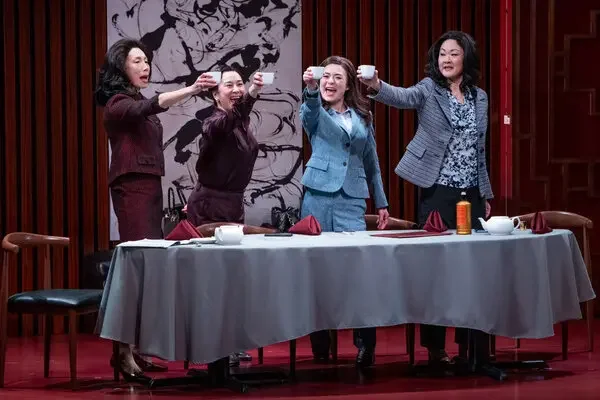
(Photo: Joan Marcus)
by Chris Peterson
I think the easiest way to misread Chinese Republicans is to walk in expecting a workplace satire and then spend the first part of the show going, oh yes, I get it, I know what kind of play this is.
Because it does flirt with that vibe right away. We’re in a Chinese restaurant. There’s a monthly lunch. There’s that familiar “corporate America but make it sharp” energy where you can practically hear the knives being sharpened under the table.
The setup is simple: four women in investment banking meet for a monthly affinity group lunch, supposedly to support each other as Chinese and Chinese American women in a white, male-dominated industry. The group is held together (and micromanaged) by Ellen, which is important, because Ellen is the kind of person who can make “support” sound like a corporate mission statement and a threat in the same sentence.
Phyllis is the senior one, the toughest one, the one who’s been in these rooms long enough to stop pretending any of this is polite. Iris is the one with the least patience, and the most to lose if this job slips away. And then there’s Katie, the bright-eyed younger newcomer whose presence basically turns the lunch from a routine vent session into a quiet tug-of-war about what survival is supposed to look like.
But that’s the thing. The workplace stuff is just the packaging. Chinese Republicans isn’t ultimately interested in being clever about work. The play is about power: who gets it, who’s locked out of it, who learns to mimic it, and what people are willing to trade to stand close to it.
And I’m not saying any of this from a comfy distance. I’m Korean-American. And I’m a former Republican. So when this play starts digging into identity, ambition, and who actually gets to feel safe inside these shiny American power structures, it doesn’t feel theoretical to me.
It feels familiar. Uncomfortably familiar.
Because I know what it is to be in rooms where you’re quietly doing math the whole time.
How much of myself do I show? How much do I soften? How much do I explain?
And I also know what it feels like to be younger and think: “If I just work hard enough, if I just play the game well enough, I’ll earn safety.” Like the system is a vending machine and if you put in enough effort, it’ll eventually drop out respect.
This play basically grabs that idea by the collar and goes: “No. That’s not how it works.”
What starts as a monthly support lunch slowly becomes more like a reality check. Sometimes it’s funny, but it’s the kind of funny where you laugh and then immediately feel weird about laughing.
Chinese Republicans sounds like it’s supposed to be a punchline, right? It’s the kind of phrase that some audiences might hear and immediately think: “Oh, this will be delicious, I can’t wait to clap at the 'right' moments.”
But the play is way less interested in giving you easy applause than it is in asking why someone ends up there in the first place, what they’re trying to protect, what they’ve been taught they have to trade for access.
There’s also this underlying idea that shared identity doesn’t automatically mean shared values, shared politics, shared methods of survival. It sounds obvious, but theatre audiences love a neat “we found sisterhood” arc. This play is not doing that. It’s doing the messier thing, which is showing you how different people can be living under the same umbrella and still speaking completely different emotional languages.
And that’s what I keep coming back to. Chinese Republicans isn’t trying to send you out of the theatre feeling celebratory. It’s trying to send you out awake.
It’s about what happens when capitalism meets identity and says: “You can belong here, but only if you perform belonging the way we like.” It’s about the lie that you can outwork racism. It’s about what it costs to be “safe,” and who gets to be safe without auditioning for it every day.
This isn’t a workplace satire. It’s a play about power: about racism that can be quiet and constant. It’s about how “support” can turn into performance. It’s about how identity can be something you protect, or sell, or weaponize, or lose. It’s meant to make you think at curtain, not celebrate.
And if you leave feeling clean, like everything wrapped up and you know exactly what side you’re on, I don’t know. You might’ve been watching the wrong play.