Why “Who I’d Be” from Shrek the Musical Is One of the Best Act One Closers…Ever
by Chris Peterson
Every now and then, a musical surprises you by being smarter—and more honest—than anyone expects it to be. Shrek the Musical is one of those cases. Buried beneath the green makeup and fairy-tale jokes is one of the most stunning Act One closers in modern theatre: “Who I’d Be.”
I’ve said it before and I’ll say it again—this song belongs in the same conversation as “Defying Gravity,” “One Day More” It’s that good. It’s just quieter about it.
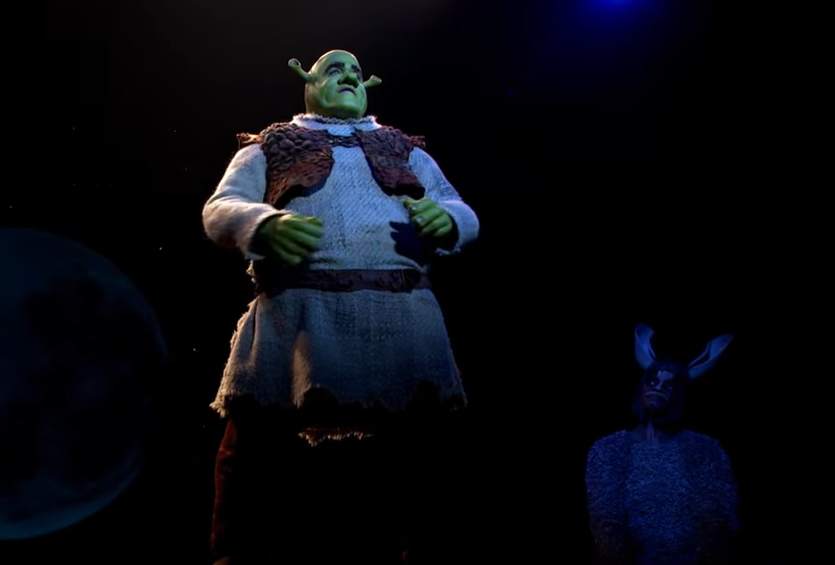
The setup couldn’t be simpler. After a long day’s journey, Shrek, Fiona, and Donkey settle by the campfire. There’s some teasing, some laughter, and then Shrek starts to open up. He imagines what life might be like if he weren’t an ogre. If he could be the hero instead of the monster. What follows is a song that starts small and ends up saying everything.
Most Act One finales go for fireworks—the kind of goosebump moment that rattles the mezzanine. But “Who I’d Be” goes inward instead. It’s a confession disguised as a bedtime story. The melody starts humble, even hesitant, and you can almost hear Shrek negotiating with himself as he dreams aloud. Then, without warning, the song grows wings. Jeanine Tesori’s score swells, and suddenly you’re swept up in something epic—but not because of the notes. Because of the truth.
What makes it brilliant is that it earns its emotion. The first act of Shrek has been all quips and quests and fairy-tale gags, so when this moment lands, it feels like a deep breath the show’s been waiting to take. The humor drops away, and for the first time, we see the ache underneath. Shrek isn’t just lonely—he’s aware of it. And worse, he’s accepted it as fate.
This is what a perfect Act One closer does: it changes the lens. Everything before “Who I’d Be” is about a mission—rescue the princess, claim the swamp. Everything after is about identity and love. The entire story pivots on this campfire.
And structurally, it’s masterful. It closes the act emotionally, not just narratively. There’s no ensemble shouting “To Be Continued!” or giant set piece flying overhead. It ends in stillness—three characters alone under the stars, all of them pretending they’re fine. That restraint is rare. Tesori and David Lindsay-Abaire trust the material enough to leave space for silence.
The song also does something else I love: it sneaks up on you. You don’t realize it’s an Act One closer until it’s already over. There’s no big cue, no telegraphed “this is the moment.” It just builds. The music rises, Fiona joins in softly, Donkey harmonizes for warmth, and before you know it—you’re holding your breath.
That subtlety is why “Who I’d Be” lasts. It’s not just a character beat; it’s a mirror. It’s about the parts of ourselves we bury because we think they don’t belong in our own story. The show may wear fairy-tale costumes, but this moment cuts right to the bone of what it means to want more for yourself.
In a way, it’s the opposite of most Act One finales. Les Mis gives you revolution. Wicked gives you flight. Shrek gives you honesty. It’s not trying to out-sing anyone—it’s trying to out-feel them.
And maybe that’s why it sticks. Because the best Act One closers don’t just make you cheer—they make you see the character differently. They make you stay through intermission not because you want to know what happens, but because you care about who it happens to.
So yes, I’ll die on this hill: “Who I’d Be” is one of the best Act One closers ever written. It’s introspective without dragging, heartfelt without sentimentality, and quietly epic in its own way. It proves you don’t need pyrotechnics to end an act—you just need a truth worth singing about.
The lights fade. The final note lingers. And as the curtain falls, Shrek’s question stays with you: if we could all be someone else—someone braver, freer, more loved—who would we be?
That’s how you close an act.