Composer Suing Playwrights Horizons Previously Recorded Crude Comments About Women and Black People
by Chris Peterson
Warning: The following article contains crude comments about women, Black people, and other marginalized communities.
A New Jersey–based composer has filed multiple legal complaints challenging diversity-focused initiatives at prominent theatre organizations, arguing that such programs constitute unlawful discrimination.
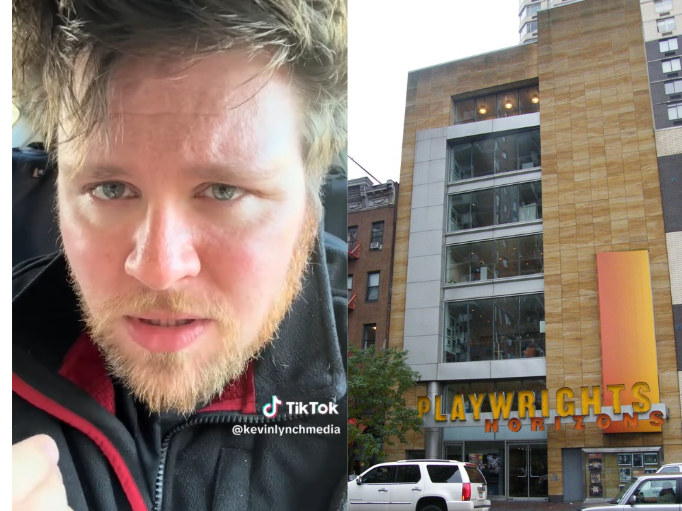
It has been reported today that Lynch filed a class action lawsuit against Playwrights Horizons, alleging that the Off-Broadway institution violated federal and state law by offering discounted tickets to Black, Indigenous, and People of Color(BIPOC) audiences for a recent production. In that filing, Lynch again argued that race-conscious policies, even those intended to broaden access, amount to unlawful discrimination.
In June, Kevin Lynch filed a complaint involving Maestra, an organization that supports women and nonbinary musicians working in theatre and film. Lynch alleged that Maestra’s membership criteria violated civil rights law by limiting eligibility based on gender identity. The complaint framed the issue as one of equal treatment and neutrality, asserting that access to professional organizations should not be defined by identity.
That’s the story as it appears on paper.
What those filings don’t show is how Lynch spoke about these issues before lawyers got involved—or how differently the argument sounded when it wasn’t being filtered through the language of civil rights statutes.
Back in March, months before the lawsuits, Lynch posted a video from his TikTok account(@kevinlynchmedia) attacking the Coalescence Theatre Project. The video has since been deleted, along with his TikTok account, but was captured on Facebook. Its content matters because it reveals the emotional core of the argument long before it was dressed up as a legal one.
In that video, Lynch referred to theatre organizations promoting work by marginalized communities as “a cancer.” He did not hedge or qualify the statement. He went on, stating “being Black or having a Twat doesn’t entitle you to have your show be heard or story be written. I want to see good storytelling.”
Later says, “this attack on cis-white men, needs to fucking stop.” The video is embedded below.
The context of that video matters. Lynch shows the Coalescence Theatre Project, an IL theatre organization that has been explicit about wanting to uplift marginalized voices, but there is nothing to suggest it discriminates against cisgender white men. In fact, its previous productions have included cis white male artists. The specific issue Lynch was reacting to was a call for plays by marginalized writers. It was one event and one initiative, not a ban, not a closed door, and not a permanent policy of exclusion.
None of that nuance appeared in the video. What came through instead was frustration with the idea that such a call should exist at all.
Lynch also invoked Stephen Sondheim in the video, claiming that if today’s inclusion-focused theatre initiatives had existed when Sondheim was starting out, Sondheim never would have succeeded. It is the kind of line that sounds provocative if you say it quickly and move on. But it does not hold up.
It’s also worth noting that Lynch has aligned himself with the group, FAIR for All, which promotes what it calls “diversity without discrimination.” On paper, that framing suggests a principled concern about how equity programs are implemented, not hostility toward marginalized communities themselves.
And to be clear, the legal merits of Lynch’s lawsuits are not the issue here. That’s for the courts to decide. What is in question is the claim of noble purpose. When crude, demeaning language about women and Black people precedes the litigation, it becomes harder to accept that this is simply about neutrality rather than resentment dressed up as principle.
When everything is placed side by side, the Maestra complaint, the Playwrights Horizons lawsuit, the deleted video, and the language that preceded the legal strategy, it becomes harder to see these as isolated disputes.
The video Lynch deleted wasn’t clumsy or poorly phrased. It was crude by design. It used dehumanizing language. It reduced complex, historically rooted efforts to something diseased and BIPOC artists as undeserving. That kind of language doesn’t come from a careful reading of civil rights law. It comes from somewhere else entirely.
Lynch may want the conversation to live only in court filings now, stripped of tone and context. But the bluntness of that earlier moment matters. You can delete a video, Kevin. But you can’t pretend the impulse behind it was ever neutral.