
by Hannah Crawford, OnStage Blog Columnist
The Orlando Shakespeare Theatre is a local theatre close to me. It is currently running the beloved classic Romeo and Juliet from January 14th through February 8th. Like most theaters, this one ran a sponsored ad on social media to boost ticket sales.
The ad shows an African-American actress, Nadia Ra’Shaun, starring as Juliet. Instead of the usual outpouring of love from the community, this ad attracted racist and antisemitic comments due to Juliet not being played by a white woman.
A couple of the hateful comments were “That’s not Juliet in the photo, is it?” and “Is this the DEI version?”


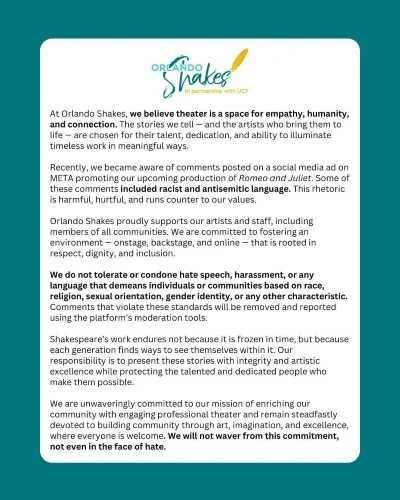
Once the Orlando Shakes were made aware of these comments, they issued a full statement to the public mere days after the ad went up.
The statement reads in part: “At Orlando Shakes, we believe theater is a space for empathy, humanity, and connection…We do not tolerate or condone hate speech, harassment, or any language that demeans individuals or communities based on race, religion, sexual orientation, gender identity, or any other characteristic… Shakespeare’s work endures not because it is frozen in time, but because each generation finds ways to see themselves within it.”
But this was only the beginning. The words have already been said. The hurt has already been delivered.
The Impact The Comments Have on Local Artists and the Theatre Community
The remarks that people like this make are not abstract. They demean and cause hurt (whether the commenters realize it or not), with their thumbs flying across their phone screens safely behind closed doors.
These aren’t just generic remarks about racism. These are comments targeting real people in our local community. These are our friends. Actors. Artists. Neighbors. Partners. Daughters. Sons. Coworkers. Comments like these tend to reinforce the exclusion that those who are not white do not hold the same standing.
What an absolutely disgusting way of looking at theatre, let alone the world.
When Bigotry Shows Up in Theatre Spaces, We Don’t Get to Look Away
In reality, could we, as a theatre community, remain silent in the face of such comments that provoke and elicit responses to feed their need for attention?
Yes, we could have technically.
However, I am a firm believer that we have a grave responsibility in our theatre community to not look away when bigotry shows up.
Say an audience member loudly harasses a performer on stage during a show. Can you imagine if the rest of the audience stayed completely silent with their eyes forward, pretending that it wasn’t happening?
Not calling something out doesn’t simply “keep the peace,”; rather, it reinforces that we are not willing to stand up to such prejudice.
Theatre is all built on choice: the choices we make in casting, interpretation, and storytelling. When harm creeps in towards one of our own, and we say nothing, we endorse the behavior and leave the targeted artist standing outside alone – exposed.
However, the Orlando theatre community here did not hesitate to stand up for one of their own. Not only did the comments flood with positive reinforcement and support, but the Orlando Shakes also took a strong public stand, saying they would not tolerate such heinous remarks.
How We Respond Matters Just as Much as Speaking Up
One thing we really need to understand is that what we say matters just as much as speaking up about it. Something I have found is that when people are upset with the things other people say or do, many respond in anger, throwing around “F**** you!” or “You’re a piece of s***.”
Now, I am the first to admit that I have a sailor’s mouth. You wouldn’t know it by how I write, but I do. However, this is the type of response that those prejudiced trolls are looking for. They are looking for the “you’re no better than me” response they were hoping for.
Now, I’m not saying I don’t understand. I’m saying that we have a responsibility to respond with an educated response. I have a gorgeous black partner who means more to me than I could possibly describe. And well, I might end up in jail if someone made comments like this directed towards her.
After all, how could someone that we love being degraded like that not be a dagger to our hearts as well? However, internet trolls like this are looking for responses that keep the conversation going rather than shutting it down.
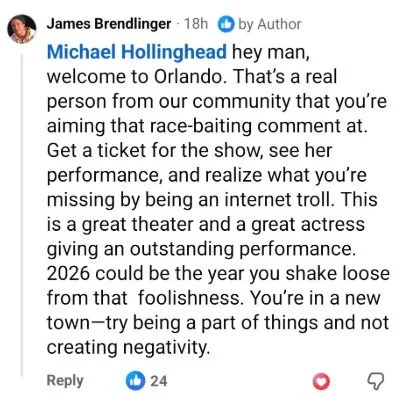
A well-respected member of the theatre community who has directed hundreds of shows and participates in school and community productions, has run their own theater, and so much more, spoke up.
He shares “hey man, welcome to Orlando” (speaking to the troll cowering on the couch in the comfort of his mother's basement that was writing the sly “Is this the DEI version?” comment.) “That’s a real person from our community that you’re aiming that race-baiting comment at. Get a ticket for the show, see her performance, and realize what you’re missing by being an internet troll. This is a great theater and a great actress giving an outstanding performance. 2026 could be the year you shake loose from that foolishness. You’re in a new town–try being apart of things and not creating negativity.”
And I get the desire to have a knee-jerk reaction when it is hurled towards someone we love and respect in our community. But when we react with profanity and personal attacks, the focus ends up shifting away from the harm that was inflicted, and is now producing nothing but noise.
Educated and well-grounded comments like the one given above help to protect our artists and defend the community we know and love.
Now, let’s bring this all back to the artist to whom this was directed. Nadia is a New York City-based theatre performer. Her love for the stage started all the way back in elementary school. She was most recently seen in the US National Tour of Hairspray and on the North American Tour of The Book of Mormon.
This artist should never have to be defended because of the color of her skin. Nadia did not earn her place on the stage because of optics. She earned it the same way every other performer does: with training, experience, and, from everything I read about her, a passionate commitment to acting.
So, you see, the comments that were thrown were not questioning her talent. It is almost as if the comments were questioning whether she should exist in the role or not. Artists of color should never have to justify their presence in a space that they belong in.
Theatre brings a lot of vulnerability both on and off the stage. We are asking our artists to be brave and to trust the support of their community. And when that vulnerability is threatened, it is our responsibility as a community to not only stand with them, but to stand in front – protecting them.