Scare Actors Deserve More Respect
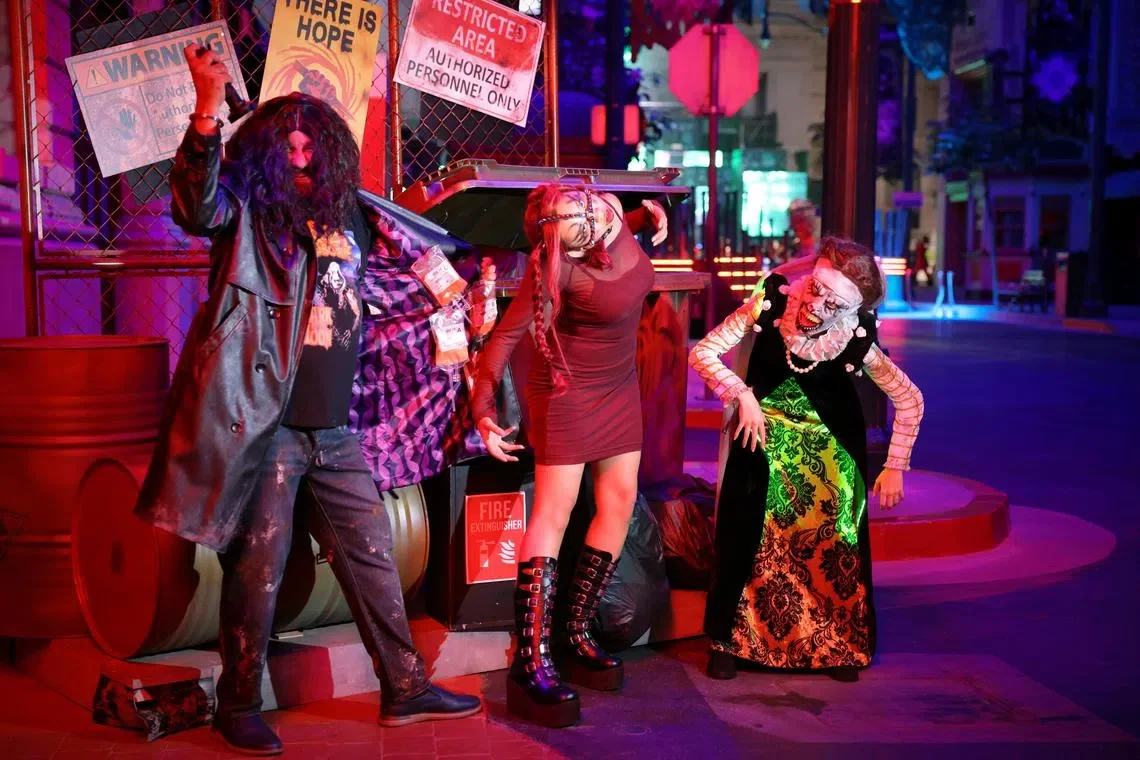
Scare actors Jag Singh, Megan Lynn and Angela Hatem Attieh at a rehearsal night for the Universal Studios’ Halloween Horror Nights. (The Straits Times)
by Chris Peterson
As a frequent visitor to haunted house attractions, I recently asked scare actors on Facebook what they wish audiences understood about the job, and a lot of the answers came back to the same thing.
People have no idea how hard this work is.
One actor put it simply: “It’s harder on your body than people realize. Injuries are common and you can even be hit by a patron.”
Another described just how long the nights can be. At their attraction, call times can begin as early as 2 p.m., even though the haunt doesn't open until 6. With more than 150 performers and only a handful of makeup artists, some actors have already been at work for hours before the first guest even walks through the door.
Then they perform. Again. And again. For hours.
As one commenter explained, “What a guest sees as a quick 2-second scare takes SO MUCH physical work to do.”
That stuck with me.
Because from the outside, I think a lot of people still see scare acting as hiding behind a wall, jumping out, and screaming their lungs out at customers. It's not.
These performers are crouching, twisting, running, screaming, crawling and repeating physical movements hundreds of times a night. They practice professional improv exercises in haunted-house settings; they're reading people, and they ad-lib dialogue based on the guests' ages and attire. They perform a quick, ten-second act all night long for a constantly changing audience
One longtime scare actor talked about knowing when to push someone toward the next room, and knowing when a guest was actually overwhelmed. They said they preferred psychological scares, using screams and cackles to start working on people before they even entered the room.
That's pretty damn smart.
Unfortunately, the other thing that came up repeatedly was how some guests treat the performers.
One actor didn't mince words:
“Don't be a dick when you walk through.”
Fair enough.
They continued: “We are still humans underneath all of the make up and masks, our humanity doesn't disappear when we're in character.”
That really shouldn't need to be said. But apparently it does.
Don't grab scare actors. Don't sexualize them. And don't decide you're going to prove how tough you are by trying to scare them back or taking a swing because they got you. All the haunted house attractions I’ve been to repeat this mantra before every performance, and yet, it is still too often ignored.
Yes, fight-or-flight reactions are real. But one commenter also made a pretty important distinction: “We can tell when making contact is intentional vs. unintentional.”
There's also another side to all of this that I really loved hearing about.
Scare actors want you to have fun.
One performer said, “Oh my god, please react and have fun,” and talked about how some of their favorite stories came from guests who completely gave themselves over to the experience.
Another said that the guests who let themselves be scared were always the most fun because they actually got what they waited in line for.
You don't win a haunted house by refusing to be scared. You paid for someone to scare you. Let them. Its like going to a Broadway show and watching a football game on your phone the entire time (and yes, I know this happens too, sigh)
And maybe look around while you're in there. One commenter pointed out how sophisticated modern haunted attractions can be, with elaborate sets, technology, and special effects everywhere. There is a lot happening beyond the person jumping out at you, just like there’s more to a Broadway musical than just people singing on stage.
But mostly, remember the person doing the jumping. Scare actors are performers.
They are people putting their bodies through a lot, both before the show and during, so you can have a great Halloween night.