(Photo: Getty Images for Tony Awards Productions)
by Chris Peterson
I have a lot of thoughts about this year’s Tony Awards. Some of them are about the winners. Some are about the broadcast. Some are the strange little choices that only theatre people will still be arguing about three days later.
So let’s start here: the things I have questions about.
Ragtime winning Best Revival of a Musical
I went into Tony night assuming Ragtime was probably going to win Best Revival of a Musical.
That was the conventional wisdom, and for good reason. It is a major revival, that arguably got robbed when it lost to The Lion King almost 30 years ago. So, when its name was called at the end of the night, I was not exactly stunned.
But I do have questions. The first one is about Cats: The Jellicle Ball.
When Cats started win early, especially for Best Direction of a Musical, I wondered whether we were watching a surprise upset slowly take shape. Best Direction of a Musical is not some random technical bellwether. Since 2000, it has been very rare(three times to be exact) for a production to win that award and then miss either Best Musical or Best Revival of a Musical. Voters tend to connect “best directed” with “best overall achievement.”
And in the case of Cats, the direction was the production. The whole point of that revival was not simply that it had been restaged, but that it had been reconceived. It gave a title many people had written off, mocked, or reduced to a punchline a new theatrical vocabulary.
So yes, Ragtime winning made sense. But Cats winning direction and then losing revival still feels like a category split worth questioning. What exactly were voters rewarding in one category that they were unwilling to fully reward in the other?
I also keep coming back to the performance choices.
The Tony Awards are, among other things, a very expensive commercial for Broadway. That does not mean every number has to be a fireworks display, but it does mean each show gets only a few minutes to make the case for itself to people watching at home. Some productions need that national spotlight more than others. So when a show has a chance to put its strongest foot forward, the choice matters.
For me, The Lost Boys, Two Strangers (Carry a Cake Across New York), and Titaníque all felt like missed opportunities. Maybe the numbers played better in context or the producers were trying to thread the needle between plot, tone, and cast availability. But on Tony night, “fine” can be deadly. If the goal is to make someone watching from their couch say, “I need to buy a ticket,” those performances did not get there for me.
The A Chorus Line tribute left me baffled.
This is one of the most iconic dance musicals ever created. Its legacy is inseparable from bodies in formation, dancers under pressure, the terrifying beauty of an audition room, and the emotional power of a line of performers moving as one. So why honor it with Rachel Zegler alone onstage singing “What I Did for Love”?
Zegler is talented, and the song is beloved. That is not the issue. The issue is that A Chorus Line is remembered because it put dancers at the center of the American musical.
If you are going to honor A Chorus Line at the Tony Awards, where were the dancers?
Let’s move onto the good.
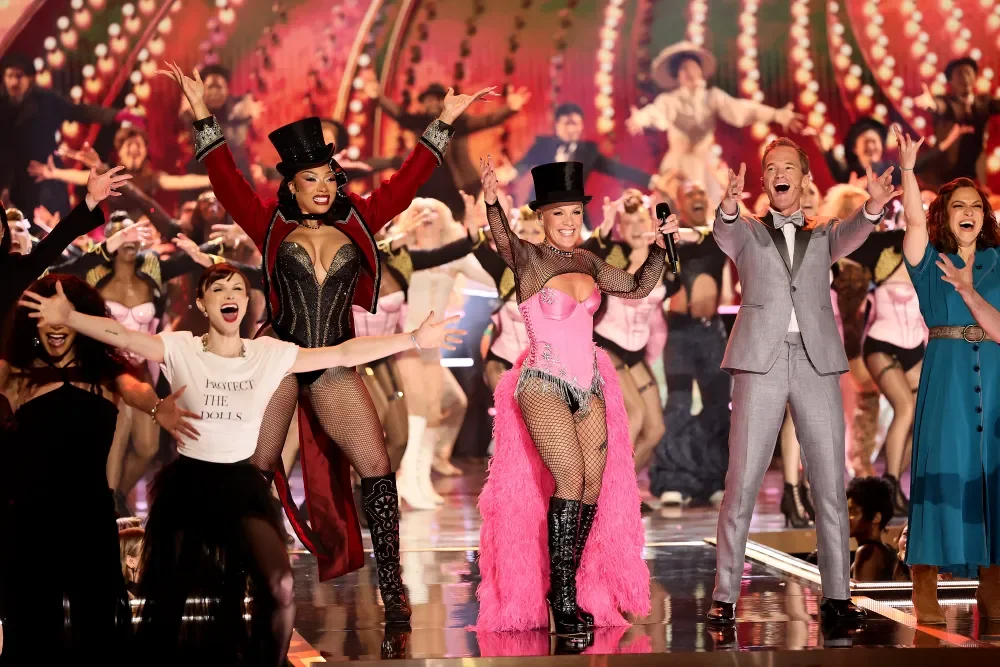
Pink pleasantly surprised me as the host.
I was curious to see how that choice would work, and honestly, I thought she handled the night well. She brought enough star power for the broadcast without making the show feel like it had been yanked away from the Broadway community. She seemed comfortable, game, and respectful of the event she was hosting. Time will tell whether that strategy helped the ratings, but purely as a television choice, I would not mind seeing her do it again.
Shoshana Bean, Caissie Levy, and Joshua Henry have the kind of Tony night that felt long overdue.
These are not performers who appeared out of nowhere. They are longtime Broadway artists who have been doing the work, earning the respect of audiences and peers for years. Nights like this are always better when they feel like the industry is not just rewarding the new shiny thing, but also recognizing the people who have been showing up at a high level for a long time.
That part of the evening really worked for me.
I thought the overall pacing of the show was one of its biggest strengths.
Nothing felt painfully long. Nothing seemed to drag the night to a halt. Awards shows often lose energy in the middle, especially when they are trying to juggle performances, tributes, speeches, comedy bits, and industry housekeeping. This one moved along nicely. Even when I had questions about some of the choices, I never felt like the broadcast had completely stalled.
The tributes were fine enough, too, and honestly, I think the Tonys should make room for that kind of thing every year.
Broadway has a living history problem on television. We talk about legacy all the time, but we do not always show it in a way that connects the past and present for the audience watching at home. Bringing back older shows, celebrating landmark productions, and including as many original cast members as possible is a smart idea. For instance, next year is the 40th anniversary of Les Misérables, 30th for The Lion King, and 20th for Hairspray, and a whopping 50th for Annie.
It reminds people that Broadway is not just whatever opened this season. It is a continuum.
At the end of the night the Tonys work best, they remind people why live theatre matters. They make stars out of Broadway performers. They give longtime artists their flowers. They introduce new shows to people who may never have heard of them. They connect the past to the present. This year had plenty of that.