Can Hadestown’s Inclusive Reputation Survive Casting Geno Segers?
by Chris Peterson
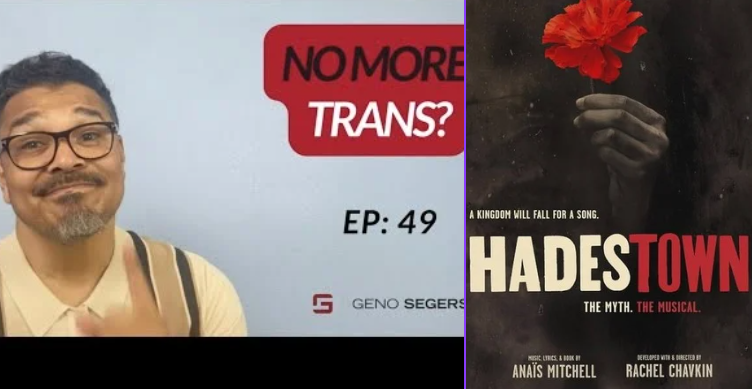
This week, the producers at Hadestown announced that Geno Segers will take over the role of Hades on Broadway beginning September 1. Segers previously played Mufasa in an Australian production of The Lion King and appeared on TV shows such as Banshee.
But Segers’ public social media history makes this casting worthy of further discussion.
Segers has posted regularly opposing transgender women participating in women’s sports. His YouTube channel includes annoyingly edited videos titled “TRANS FAIRNESS?,” “HE… I MEAN SHE, BROKE THE RECORD” and “NO MORE TRANS?”
In a now-deleted video from 2024. He compares trans people asking for equal rights to people pretending to be dogs for discounted airfare. He then goes on to say, “I don’t see trans people becoming oppressed…life is unfair.”
This is not one isolated comment or someone else’s interpretation of his beliefs. It is a recurring subject in multiple videos and captions Segers has chosen to publish under his own name.
People will immediately argue that actors are allowed to have political opinions. Of course, they are. A Broadway company cannot require every performer to vote the same way or agree on every public-policy question.
But this conversation becomes more complicated when those opinions concern the identities and dignity of people who may be working alongside you, especially when you are cast in Hadestown.
The show has a particularly visible relationship with gender-expansive casting. J. Harrison Ghee, a nonbinary performer, is currently playing Hermes but is departing on August 30. Alex Lugo, who identifies as nonbinary, is a swing in the company and will remain with the production after the September cast change. The show’s original West End company included Allie Daniel, an openly transgender actress who played one of the Fates and covered Hermes. The show’s official licensing information specifically identifies roles for nonbinary actors.
So the questions surrounding Segers and his social media posts are not hypothetical.
How do his publicly expressed views translate inside a rehearsal room with Alex? Will he consistently respect and use his colleagues’ names and pronouns? I ask this because in another video, Segers mocks people who ask for his pronouns, suggesting the question should be unnecessary because he is not wearing a dress. The joke relies on the idea that someone’s gender identity should be obvious from their clothing and treats the basic practice of asking for pronouns as something absurd.
Does he consider trans women to be women when they are standing beside him backstage, even as his social media posts describe trans female athletes as men? Just last October, he made a post on X mocking trans men.
This sounds like a potential HR disaster.
It’s also fair to ask if the producers knew about these videos before offering him the role? Have they discussed them with him? What protections are in place should a company member feel that his public rhetoric is contributing to an uncomfortable or hostile working environment?
Those are fair questions.
Hadestown has earned considerable goodwill from queer, trans, and nonbinary audiences because of the people it has placed on its stage. These performers are employees who deserve to know that their identities will be respected by the people hired to work beside them.
Segers is about to play a man who builds walls because he is afraid of losing control. Before he heads underground, both he and the producers should be willing to answer whether the views expressed aboveground are compatible with the company Hadestown claims to be.