Greg Ehrhardt, OnScreen Blog Editor
I am overall delighted with the success of the movie adaptation of Wicked for a few reasons, chief among them being that it confirms my priors that musicals can still reliably bring audiences to the movie theatre (alongside horror movies and, for maybe a couple more years, superhero movies).
Wicked is in my short list of best stage-to-screen adaptations; you can make a real argument that it’s the best. After seeing “Wicked: For Good”, I’m a bit more hesitant in making that claim, but it is still a fresh experience for me and audiences nationwide.
Other than some major quibbles I had with Wicked: For Good, despite my overall feeling that Jonathan Chu landed the plane, I did leave the theater thinking:
“Is Elphaba a little too much of a heroine?”
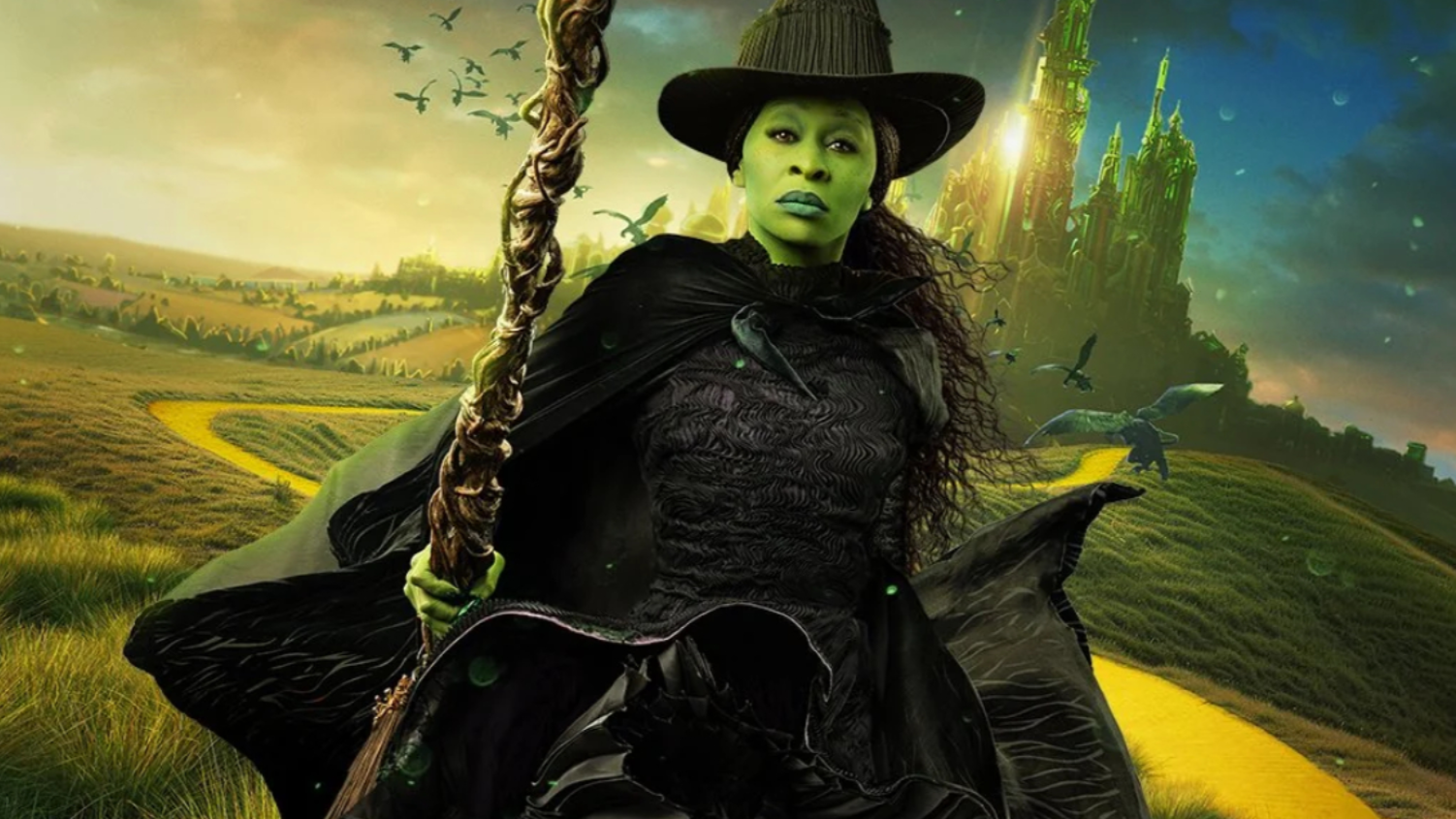
If I had no prior knowledge of the Wizard of Oz IP, I wouldn’t have this thought; Wicked (both on stage and screen) does an excellent job establishing the moral framework of Glinda and Elphaba. However, the problem with basing your worldview on Wicked alone is that it wouldn’t exist without the Frank L. Baum book and 1939 movie, from which Wicked draws its source material and, more importantly, its popularity. More to the point, “Wicked: For Good” tries to retcon most of the events of the 1939 Wizard of Oz movie to fit its narrative. It doesn’t pretend to exist within its own fairy tale. It tries to exist within the 1939 framework, a framework in which the Wicked Witch of the West is unapologetically cruel and evil.
Which brings me to the conceit of this editorial: Did they make Elphaba TOO good-hearted? Is this a villain origin story gone wrong?
The consensus among Hollywood circles is that audiences have evolved in their understanding of evil. All villains, on screen and perhaps in real life, think they are the heroes of their own story. As the Wizard points out in “Wicked: For Good”, history is written by the victors, and, as some people say in 2025, even a pancake has two sides.
All well and good.
We’ve had some terrific villain portrayals where the audience genuinely feels sympathy for their cause. Thanos, Commodus (more on him later), Magneto, and Killmonger are some that come to mind from other blockbuster movies.
The key to all four villain performances listed above is that, while their motivations are understandable and very human, the conclusions they draw are irrational and homicidal, sometimes even genocidal. The audience can identify with the root causes, but not with the choices they make as a result. The villains often think there is only one choice, and they never seek counsel or a buddy to bounce their ideas off. Their minds are made up, and they are stubborn. These are not character traits audiences want to root for.
With Elphaba, we are supposed to identify with her motivations AND her resulting actions. She is an animal activist and a liberator of Oz. This is the point of Wicked; she and Glinda are heroes, and the Wizard and Madame Morrible are outright villains. This works in a vacuum (a movie is only as good as its villains!) but is irreconcilable with any preceding Wizard of Oz movie adaptation, as well as the book it's based on.
“This is the point of Wicked, you dingus!” you might be saying.
Well, it might be the point of Wicked, but the Act Two film adaptation destroys the rewatchability of one of the most famous movies of all time. How do you re-watch the 1939 movie (which is alive and well in the cultural zeitgeist due to its showcase at the Sphere), featuring Margaret Hamilton’s transcendent villainous performance, with Elphaba’s character in Wicked in mind? Wicked doesn’t put that into context; it eviscerates it, rendering it meaningless.
Again, you may say, “So what, it’s 2025!”.
And until I watched “Wicked: For Good”, I would have agreed with you.
The problem, though, that crystallized for me after seeing “Wicked: For Good” was “Well, when are we getting Madame Morrible’s origin story? Maybe she’s a hero in another story we haven’t seen yet!”
And that, to me, amounts to a trust issue that audiences can have with Hollywood. How do we invest ourselves in the morality presented on screen through its heroes and villains, only to have it entirely flipped on its head when Hollywood (or Broadway) decides to?
The Wizard in “WFG” is a very bad man, Elphaba proclaims. Well, maybe he has a sympathetic backstory just like Elphaba? Perhaps he’s not just a hero in his own story but another story we haven’t seen yet?”
See the slippery slope we’ve created?
The only logical response is “Well, Madame Morrible and the Wizard are the REAL bad guys, they’re irredeemable!”
Well, we thought that of the Wicked Witch of the West too, at one point. How can we trust that anyone we see on screen is good or evil anymore?
To be clear, this is not a Wicked problem, but a Hollywood problem, and an academia problem too. We often hear from them that there is no black and white morality, just shades of gray and alternative perspectives on history (a point the movie also makes, ironically).
There is a lot of truth to that in the real world, but the problem is that certain types of people that Hollywood and academia perceive as the “true” bad guys. There must be a real bad guy for a movie to work. However, if you genuinely believe in the thesis of two sides to a pancake, then it must apply to everyone.
But, while there are some examples on the small screen (Game of Thrones comes to mind, well, besides Joffrey and Ramsey), no one ever does that in the movies.
The sad part is, it really doesn’t have to be this way. I previously mentioned Commodus from Gladiator, for he is the gold standard of a sympathetic and human on-screen monster. Gladiator presented his origin story as well as the showcase of his outright cruelty, and they blend perfectly together. You feel horrible for him as a son who just wanted the love his father showed to Maximus, but the choices he makes as a result of that are inarguably evil, for we always have a choice to do right or wrong, regardless of our circumstances.
That dilemma is never presented in Wicked, partly because, according to the Wicked source material, there was no wrong choice! When the Wicked story was faced with explaining Elphaba’s treatment of Dorothy and the Scarecrow in the book and the 1939 movie, it essentially whitewashes it away (talk about history being rewritten by the victors!).
“Wicked: For Good” isn’t the only movie to fail this logic. The movie Maleficent essentially does the same thing as Wicked, but much less effectively. The REAL villain is King Stefan! He’s the ambitious, cruel antagonist of the whole story! Maleficent is the hero after all!
But what’s King Stefan’s origin story? Is he redeemable? Will we get a King Stefan origin story in 10 years? (Disney, don’t get any ideas)
Ultimately, my frustration boils down to this. It is great that villains are humanized in storytelling. They become more real, and thus scarier. However, if we continue down this road, where villains are not just sympathetic but also good in pretty much every way, then we lose the rollercoaster element of movies that makes them so much fun. My favorite part of watching movies with my daughter is hearing her actively root for the villain to go down. She became viscerally mad at Dolores Umbridge while watching Harry Potter and the Order of the Phoenix. She was overjoyed when Umbridge got what was coming to her. If they ever (God forbid) give Umbridge the Elphaba treatment and reveal that she was actually the hero of that movie, then the rollercoaster ride of The Order of the Phoenix will be ruined.
Movies shouldn’t just be fun in the moment. They should try to be fun and memorable forever. And the culture will be at a loss if we continue to rewrite great movies to meet the sensibilities of today.
After all, the one truth that has been confirmed over thousands of years is that good people sometimes make terrible, awful choices for terrible reasons.