This Super Bowl Sunday, Put “Good News” Back in the Game
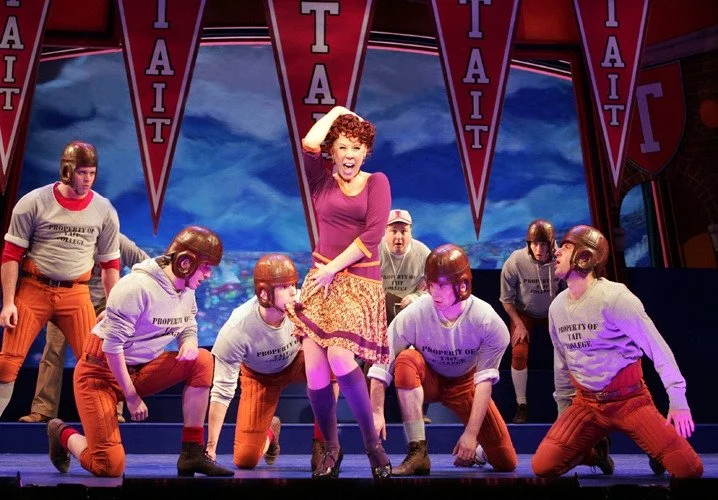
Photo: Goodspeed Musicals
by Chris Peterson
Super Bowl Sunday turns everybody into a football philosopher. Suddenly, your cousin is explaining coverages, your uncle is critiquing play-calling like he’s on an NFL sideline, and someone is absolutely yelling about clock management before the appetizers even hit the table.
Meanwhile, I’m over here thinking about Good News.
Yes, Good News — the 1927 football musical that theatre people either adore, vaguely remember, or have never heard of because we collectively keep programming the same fifteen titles on a loop.
And look, I get it. Safe picks are safe for a reason. But if there were ever a day to make the case for this show, it’s today.
My high school did Good News in my sophomore year. I wasn’t in the cast, which still feels like one of those weird personal theatre tragedies you carry forever for no reason. But I remember watching it and thinking, this is a blast. The energy was huge, the ensemble looked like they were having the time of their lives, and the whole thing had that old-school musical comedy charm that hits when a school leans all the way in.
That’s why I keep coming back to this point: high schools and colleges should perform Good News more often.
First, it’s built for student performers. You’ve got big ensemble opportunities, strong featured roles, dancing that can be as ambitious as your program can handle, and a world that feels inherently playful. It gives you football stakes without needing to literally stage a Super Bowl at midfield. It gives you romance, comedy, pep, rhythm, and campus chaos. It moves.
Second, it gives programs a chance to do something that feels fresh even though it’s a classic. In school theatre, we talk a lot about “introducing audiences to new work,” but we forget that old work can feel new too when people haven’t seen it in years. Most student audiences aren’t walking in with fixed expectations for Good News. That’s a gift. You get to define the show in the room instead of competing with whatever revival or movie version lives in everyone’s head.
Third, it’s fun in a way that is increasingly hard to find. Not ironic fun. Not “we all survived tech week” fun. Actual, joyful, high-octane, jazz-hands-meets-football fun. The kind that reminds students why they auditioned in the first place. The kind where every person onstage looks like they’re part of the same party.
And yes, I know the objections. “It’s old.” “Do kids connect with it?” “Will it sell?” Fair questions. But “old” isn’t the same thing as “dated beyond repair,” and a smart director can shape tone, pacing, and design choices so it lands right now.
As for selling tickets, school communities tend to show up when the production feels alive, confident, and big-hearted. This one can absolutely do that.
I also think there’s educational value here that people underestimate. Doing Good News lets students sit inside a different era of musical theatre and figure out what still works, what needs context, and how performance styles evolve. That’s not dusty history. That’s training. It stretches instincts. It sharpens taste. It teaches the cast that theatre didn’t begin in 2003.
Most importantly, it gives a lot of different students a place to shine. In an era where so many shows become “the leads and everyone else,” this one rewards ensemble storytelling. You can build community with a show like this. You can build confidence. You can give students the feeling that they weren’t just adjacent to the production — they were the production.
So on the biggest football day of the year, I’m making my pitch for the little football musical that deserves better. Not because it’s trendy. Not because it’s obscure and therefore cool. Because it works. Because it’s joyful. Because students can do great work with it. Because audiences can have a genuinely good time with it.
And because sometimes the best programming move isn’t chasing the loudest title. Sometimes it’s betting on the show with heart, rhythm, and a little bit of pep-band magic.
On Super Bowl Sunday, that feels like very, very good news.