Dear High School Directors, Please Don’t Trash Your Students Online

by Chris Peterson
This seems obvious, and frankly, this feels like an article I should not have to write, but here we are.
If you are a high school director, and perhaps rehearsals aren’t going well, please do not go into a public Facebook group and trash your students.
A high school director recently posted in a public theatre educator group asking for “positive suggestions” about a student they had cast in a lead role. That sounds innocent enough until you get to the part where they describe the student as someone who “cannot sing at all,” “cannot match pitch,” “cringes with every note,” and is “blissfully unaware” of their lack of skill.
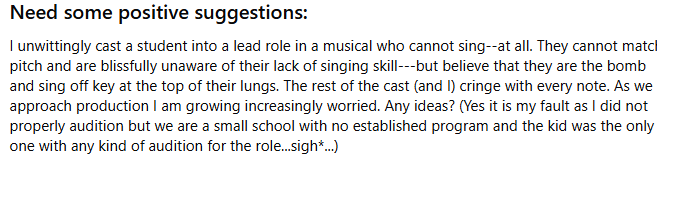
The public post was made under the director’s real name, in a public group, which means it would not take much effort to figure out the school, the production, and possibly the student being discussed. The student could have seen it. Their classmates could have seen it. Their parents could have seen it.
And that is the only reason I am not showing the director’s name here, not because they earned that courtesy, but because the student did.
Let’s be clear. If you cast a student in a role they cannot handle, that is on you. I understand that schools are difficult, as well as the inherently limited audition pools. But you still made the choice.
You do not get to hand a student a lead role, realize later that your audition process did not tell you what you needed to know, and then run to Facebook to basically say, “Can you believe this kid I cast isn’t good enough?”
That is not a student problem. That is an adult problem.
There were so many better ways to ask the question. “I have a student struggling vocally in a lead role. What are some supportive strategies to help them succeed?” See? Same problem: less cruelty. Amazing how that works.
High school theatre is supposed to be a place where students learn. They are going to miss notes. They are going to overestimate themselves. That is part of working with students.
Your job is to teach, guide, and protect them. If a student cannot sing the role, adjust the music. Bring in vocal support. Change expectations. Restage moments. Have a kind, honest, private conversation. Do the directing part.
But if your response to a struggling student is to humiliate them online, maybe you are the one who has no business directing the show.