The Emotional Politics of Headsets
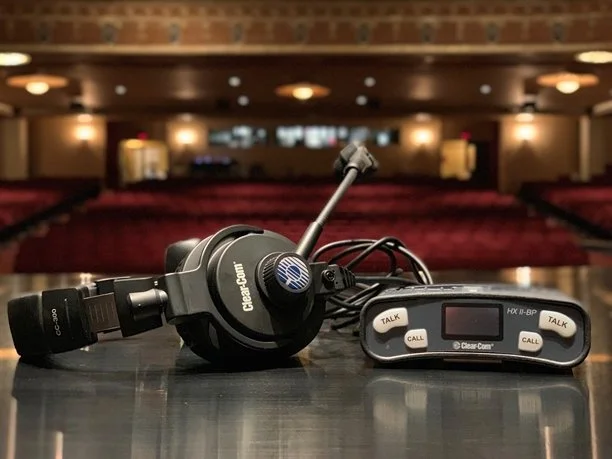
by Chris Peterson
There’s another show happening during every performance that most of the audience never hears. It’s the one happening on headset.
While the actors are onstage doing their thing, there’s an entirely different group of people sitting in the dark calling cues, moving scenery, tracking props and quietly trying to make sure the whole thing doesn’t go sideways.
And depending on the night, the conversation on headset can be just as entertaining as anything happening onstage.
Anyone who has ever worn one knows there’s a very specific culture to it. You learn pretty quickly when to talk, when not to talk and how much can be communicated with one long exhale. There are nights when everyone is relaxed and joking around, and others where one person saying, “We have a problem,” can make the entire booth go silent.
That silence usually means everyone is trying to figure out exactly how bad the problem is.
The stage manager is in the middle of all of it, calling the show while also keeping track of whatever is happening backstage. Maybe a prop isn’t where it’s supposed to be. Maybe a piece of scenery isn’t moving. Maybe an actor missed an entrance and three departments are now trying to adjust without the audience realizing anything happened.
Meanwhile, the light board operator is waiting for the next “Go,” and the sound operator is probably staring at a microphone level that suddenly makes no sense.
Then someone backstage comes over headset.
“The table is set.”
A minute later: “We can’t find the chair.”
And somehow that chair is now the most important object in the entire theatre.
That’s what I always loved about being on headset. You get to hear the problem solving in real time. Sometimes it’s a legitimate emergency, and sometimes it’s five people trying to figure out who moved a prop that eventually turns out to be exactly where it was supposed to be.
The audience usually never knows any of this is happening.
They don’t know someone just repaired a costume in the wings or that a microphone battery is being changed with seconds to spare. They just see the next scene start.
That’s really the job.
A lot of the best backstage work is work nobody notices. If a transition happens smoothly, a cue lands exactly where it should or a problem gets fixed before the audience realizes there was one, the people on headset did what they were supposed to do.
And theatre doesn’t always give those people enough credit.
We talk about the magic of live performance, but a lot of that magic is actually somebody backstage with a flashlight, somebody at a board staring at a cue list and a stage manager calmly saying “stand by” while several people are trying to fix something.
There is also a weird camaraderie that comes with it. You spend enough performances together on headset and you start learning everyone’s voices, moods and little habits. You know when someone is joking, when someone is annoyed and when that slightly-too-calm tone means something has gone very wrong.
Then the problem gets solved, the cue happens and somebody quietly says, “Nice.”
Five seconds later, someone asks where the chair went.