
Greg Ehrhardt, OnStage Blog Editorial Staff
For someone who has spent nearly a decade writing and editing pieces about theatre for OnStage Blog, never mind decades of enjoying live theatre, until recently, I had never actually acted in a community theatre production.
That changed when I was cast in The ReGifters, a Christmas comedy that will be performed in Connecticut (you can read about my audition here)
And while I expected to learn a lot about acting, I didn't anticipate just how many of my assumptions about the process would prove completely wrong.
So, as someone experiencing community theatre for the first time, here are five things that have surprised me the most about the acting and rehearsal process.
A couple of things to keep in mind before I get to the list:
1) Our performance is still a month away, and we just got off book a few days ago.
2) To experienced performers, none of my revelations will be shocking, and in fact, we have discussed these ideas in many previous editorials.
Still, it is something to experience this firsthand, and I share this in the hope all performers continue to appreciate these findings even more.
1. Memorizing Lines Isn't That Hard. Knowing When to Say Them Is Much Harder.
Before this experience, my biggest fear about acting was forgetting my lines, as you can see here.
It's actually one of the primary reasons I avoided auditioning for a play for so long.
But here's something I didn't expect: memorizing lines really isn't the hard part of the line delivery process, though don’t get me wrong, it has its challenges.
With enough repetition, you can get the words into your head. I found the process similar to memorizing song lyrics, especially when the dialogue is written well and naturally. One line feeds another; for me, the initial three words of the dialogue feed the rest of my lines.
What nobody adequately prepared me for was how much harder it would be to remember WHEN to say them.
Because it turns out, you also need to know your scene partners' lines, or at least the important ones that cue your responses.
And even that doesn't entirely solve the problem.
You have to actually listen.
That sounds obvious, but it's challenging when you're standing on stage, concentrating on your blocking, thinking about your character, and waiting through a lengthy stretch of dialogue before your next line.
It's tempting to mentally rehearse what you're about to say rather than fully engage with what everyone else is saying.
I can’t tell you how many times I have jumped early with my line because I panicked that I was going to miss my cue. I’ve done that way more often than messing up a line.
Repetition helps reduce those mistakes. But remembering when to say my line and listening for the right cue have been my biggest line-delivery challenges to date.
2. Practicing at Home Is Nothing Like Rehearsing On Stage.
I've spent plenty of time practicing my lines at home; sometimes by myself, sometimes with my wife, and sometimes with my daughter.

I genuinely appreciate their help and their patience when I am reciting lines while making breakfast or doing chores (never waste a moment!).
But of course, my family are not experienced actors.
They deliver lines at different speeds, usually faster than my cast, because that’s what amateur actors do.
I can run through a scene at home a dozen times and feel like I've absolutely nailed it.
Then I show up at rehearsal, and suddenly the entire rhythm changes; I panic.
And that perfectly memorized exchange from my living room feels completely different. I freeze, and call “Line”.
It's a reminder that acting is a collaborative process.
You can prepare as much as you want individually, and you absolutely should. But you cannot recreate the chemistry, pacing, movement, and energy of an actual rehearsal in your house.
There is simply no substitute for being on stage with the people you're performing alongside, unless you live with experienced actors of course!
3. Stage Managers Are Wildly Underappreciated.
I've always understood that stage managers are important; we’ve written about them several times for onstageblog.com.
But after experiencing the rehearsal process firsthand, I'm beginning to think they're among the most underappreciated people in all of theatre (maybe even in all professions, why not!).
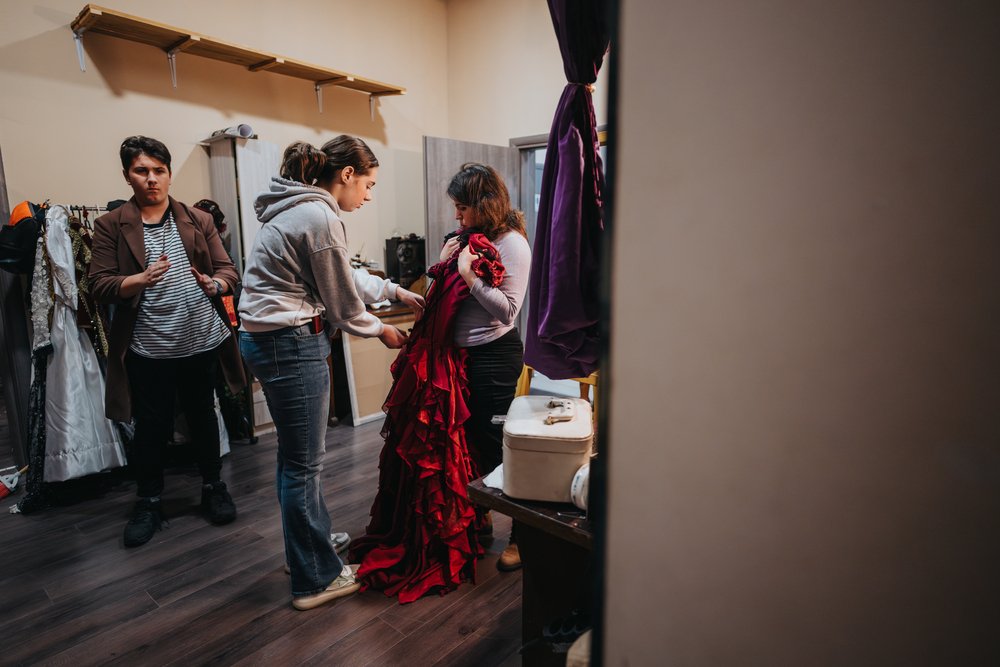
The sheer number of details they have to manage is overwhelming to someone like me who just wants to focus on the big picture.
Blocking notes. Props, but not just any props. Props that make sense for the character to use. My instinct is always to say “Good Enough!” in theatre, but “Good Enough” is not nearly good enough when every detail matters, because audiences WILL PICK UP ON THE SLIGHTEST OF INCONGRUENCIES!
But the list of responsibilities for stage managers continues. Rehearsal logistics. Costumes; boy, was the costume selection process an awakening for me. I brought a pair of tan khakis for my character costume, and the stage manager asked if I had a different shade of tan. I didn’t object; she was right! But that’s not something I would have picked up on in a hundred years.
And all of that is before you even get into the technical elements of putting on a show and probably a dozen more responsibilities I’m forgetting at the moment.
I've always believed that people can learn to be successful at just about any job with enough effort and dedication.
But after watching how much work goes into keeping a production organized, I genuinely cannot imagine how a show functions successfully without a detail-obsessed person filling that role.
We should probably be applauding stage managers a whole lot more than what we are currently doing.
4. Apparently, Having at Least One Difficult Actor Is Normal. Why?
During rehearsals for The ReGifters, I've had conversations with a few cast members about their previous community theatre experiences.
They all told me that this was the first production they'd been involved with where there wasn't at least one problematic actor.
Wait. What?
Apparently, dealing with someone who is consistently difficult, unreliable, disruptive, or simply unpleasant is considered an almost unavoidable part of community theatre.
Maybe I'm being naive because this is my first production, but isn't it easy to just be a decent person?
Show up on time. Support your fellow actors. Don't unnecessarily miss rehearsals. Don't make everything about yourself. Don’t argue with the director or your fellow actors.
None of this seems particularly complicated.
Yet based on the stories I've heard, these basic expectations are almost always never met
This raises an interesting question about casting.
We talk endlessly about talent, stage presence, singing ability (when it comes to musicals), and whether someone looks right for a particular role when discussing the casting process.
But how much consideration do we give to whether someone is pleasant to work with?
Should community theatres do more to seek out references from previous directors and castmates, particularly when casting leading roles?
After all, a talented actor who makes everyone else's life miserable can damage the entire rehearsal process.
I thank God that my first community theatre experience has been with such a great and supportive cast. Despite their experience, they have made me feel like one of them. I can’t imagine committing to this process if I didn’t enjoy going to rehearsal every time.
If my fellow actors are right that a drama-free production is unusual, maybe community theatre has been prioritizing the wrong things.
5. Your Character Doesn't Have to Be Fully Developed Right Away.
This might be my biggest surprise of all, given my personality type.
I’m generally impatient, not with others, but with myself. When I picked up golf, and later volleyball, I wanted to be good within a couple of weeks. That’s my drive.
Before joining The ReGifters, I assumed actors were expected to figure out their characters relatively early in the rehearsal process. And that’s what I strove towards.
I imagined that by the time rehearsals were well underway, everyone would have established their character's personality, motivations, mannerisms, and line delivery, and scenes would be pretty finalized after the first couple of rehearsals after blocking was finished.
Boy, was I wrong.
What I've learned is that developing a character is a living, breathing experiment.
Something that works on day 15 might not work on day 30. Something you discover on day 45 might completely change how you approach a scene.
Sometimes an idea works beautifully.
Sometimes it falls completely flat.
And sometimes you realize that a choice you've been making for weeks isn't nearly as effective as you thought it was.

My picture of my character on day one isn’t close to where I eventually landed, with the help of my director and fellow actors. And it still might change from here until performance night.
I used to think an actor's job during rehearsal was to establish a performance and then repeat it consistently.
Now I'm realizing that much of the job is figuring out what that performance should be in the first place.
But getting there requires a lot more trial and error than I ever imagined.
Participating in The ReGifters has given me a whole new appreciation for what goes into creating those performances.
And I can’t wait to find out what more I have to learn.