
by Chris Peterson
I recently saw a question come up in a Facebook group about “frozen reads” at community theatre auditions, and I’ll admit it made me pause.
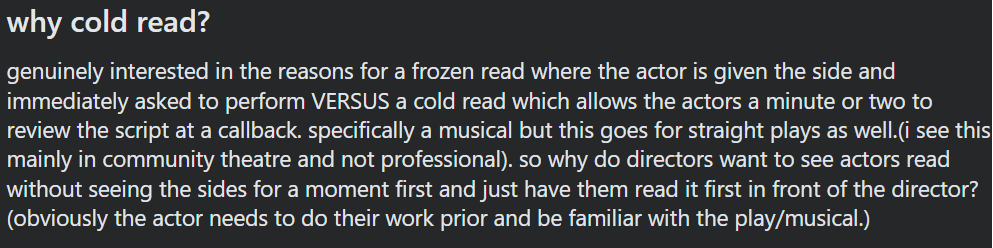
The idea of a “frozen read” caught my attention because, as an audition practice, I don’t think it serves actors or directors especially well.
Cold reads are already a strange little part of the audition process.
Here’s what a cold read entails; you walk into a room, get handed a scene you may have never seen before, take a few minutes to scan it, and then try to make something honest happen with another person while a table of people watches you.
Some actors are very good at that. Some wonderful actors are not. A cold read can favor people who process quickly, who are comfortable taking risks in front of strangers, or who happen to connect immediately with that particular piece of material.
So no, cold reads are not perfect. But they can be useful.
A “frozen read” is different. By that, I mean an audition read where the actor is expected to deliver the scene in one fixed, predetermined way, with very little room to interpret the material or respond to direction in the moment. The actor is not really being invited to explore the scene. They are being asked to land on a version that already seems to exist before they begin.
I do not think they serve the room very well.
Community theatre auditions are already stressful enough. Most of the people auditioning are not coming in after an afternoon of vocal warmups and character research.
That does not mean the audition should be casual or unprepared. Directors have every right to run an organized room. They should know what they are looking for. They should choose sides that reveal something useful about the roles. They should give actors clear expectations.
When an audition read becomes too fixed, it can start to reward the actor who happens to guess the expected tone, rhythm, or attitude most accurately. That may look efficient in the room, but I am not sure it tells the director enough about what the actor would be like in rehearsal.
Rehearsal is a process of trying things, adjusting, listening, and building something with other people over time. A good audition should give at least a small glimpse of that process.
This is especially important in community theatre, where directors are not only casting talent. They are casting collaborators, people who will sit through long rehearsals after work, adapt when a scene is not landing, take notes without taking them personally, and help create a room where other people can do good work too.
A frozen read does not give much space for that.
It can also make actors more cautious. Instead of making a clear choice, they may start watching the director’s face, trying to figure out whether they are “doing it right.” That is rarely when actors are at their best. Most actors read better when they feel allowed to participate in the scene, not simply pass a test.
There are better ways to keep an audition focused.
Give actors a short setup before the side. Tell them what matters in the scene. Let them read once. If needed, give a simple adjustment and ask them to try it again. You do not need to turn the audition into a full acting class. Even one brief redirect can reveal a lot.
Can the actor listen?
Can they shift?
Can they stay connected to the other person?
Can they make the material feel a little more alive the second time?
Those answers are usually more useful than whether they arrived at the “correct” version on the first attempt.
Cold reads will probably always be part of community theatre auditions, and that is fine. They are not flawless, but when handled well, they can be generous.
Frozen reads, though, feel like they remove the part of the audition that actually matters most: the possibility that something unexpected, human, and useful might happen in the room.