‘Beaches’ Should Have Worked. That’s What Makes This So Frustrating.
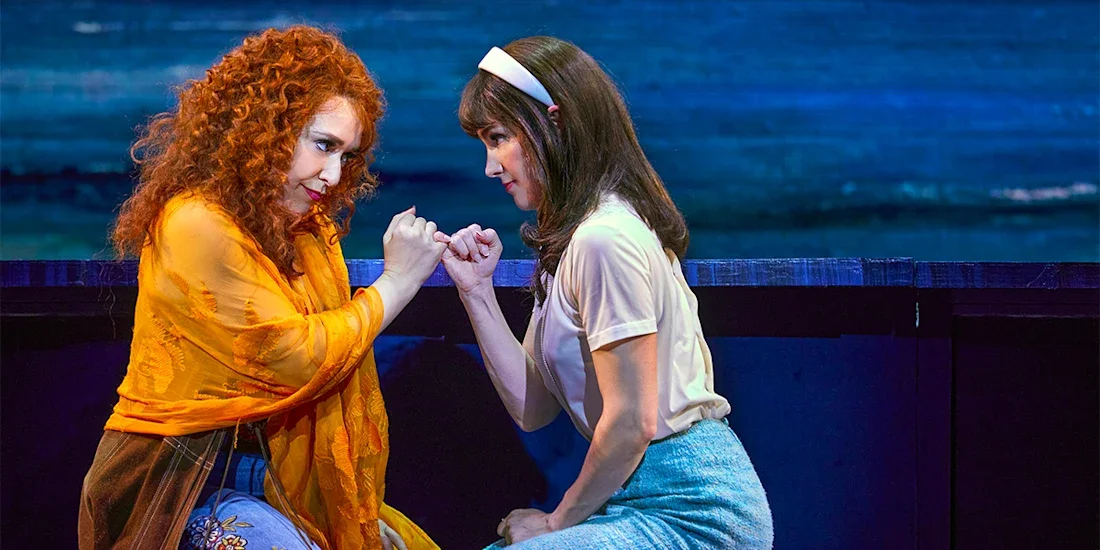
Jessica Vosk and Kelli Barrett in Beaches (Photo by Trudie Lee)
by Chris Peterson
The news that Beaches will close early on Broadway is frustrating, not because it is shocking, but because, on paper, this should have worked.
In fact, I previously wrote that Beaches was one of the clearest examples of a show that seemed perfectly positioned for the current Broadway audience.
The book and the 1988 film were not just some forgotten title pulled from the nostalgia bin. For a generation of women who came of age in the late 1980s and early 1990s, Beaches was a cultural touchstone.
That matters because this is exactly the demographic Broadway keeps trying to reach: adults with emotional attachment to familiar stories, disposable income, and a willingness to pay for a night out if the material feels worth it. Beaches had title recognition. It had decades of goodwill. It had a story built around friendship, memory, ambition, heartbreak, and big emotional payoff.
It also had Jessica Vosk.
That alone should have been a major selling point. Vosk, playing Cee Cee, is one of the most exciting vocalists working in musical theatre today, and casting her in a role associated with a larger-than-life entertainer made sense. Opposite her was the always fantastic Kelli Barrett as Bertie, the lifelong best friend role known from the film as Hillary Whitney.
They, along with the ensemble, musicians, crew, and everyone giving their energy eight times a week, deserved a production that met them at their level.
Unfortunately, the show itself did not.
And critics said as much. Vulture wrote that the production put “a ton of performing talent” in service of “enormous and unexamined clichés.” Time Out called it “a mediocre musical weepie.” Talkin’ Broadway was even more direct, writing that “there is little else that rises to the level of what we expect from a full-scale Broadway musical.”
At some point, we can’t keep blaming audiences for not showing up when the work is not strong enough. The creative team has to deliver. Familiar intellectual property is not a substitute for a compelling book. A recognizable title is not a substitute for a strong score. Nostalgia is not enough if the stage version does not justify its own existence.
What made this more glaring was how little the production seemed to reflect the world of today. For a story about women, friendship, identity, and the people who shape us across a lifetime, the lack of diversity in the cast was impossible to ignore.
Only one person of color was part of the company, Zurin Villanueva. In 2026, for a new musical opening in New York City, that is not a small detail. It is a choice, whether intentional or not, and it made the production feel dated before the curtain even went up.
The most disappointing part is that the Broadway run often felt less like the destination and more like a promotional stop before the tour and licensing life. That feeling was only reinforced when, in the same breath as the closing announcement, producers also announced plans for a national tour.
Of course, tours and licensing are part of the business. But when a show opens, struggles, closes quickly, and then immediately pivots to “the tour is coming,” it raises a fair question: was Broadway ever treated as the place where this production needed to fully succeed, or was it primarily a launchpad for the next phase?
Broadway audiences can sense when a show has not been given the full effort, resources, or creative urgency required to survive here.
The cast did their jobs. The crew did their jobs.
But Beaches needed more than affection, brand recognition, and a tour plan. It needed a better musical. And everyone involved, including the audience it was clearly trying to reach, deserved better.