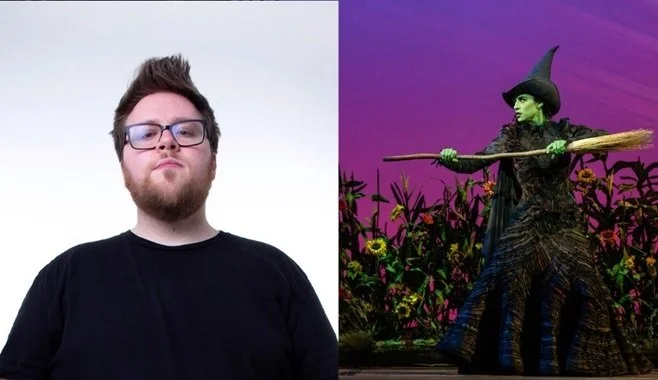
(Photo: Joan Marcus, www.youtube.com/@kevinlynchmusic
by Chris Peterson
Kevin Lynch did not get into a Wicked opportunity. So naturally, he went to federal court.
According to a lawsuit filed in Manhattan, Lynch, a composer and music director, claims he was blocked from applying for Wicked’s “Music Director Experience” because he is white and male. The opportunity was connected to Maestra, which was founded by composer Georgia Stitt, and supports women and nonbinary musicians, and MUSE, which supports musicians of color. Lynch argues that limiting the applicant pool to those directories violated anti-discrimination laws. The lawsuit is backed by the American Alliance for Equal Rights, the conservative legal organization founded by Edward Blum.
So congratulations to Broadway. After decades of white men somehow finding work in theatre, we have finally arrived at the crisis point: Kevin Lynch has encountered a room that was not immediately built around Kevin Lynch.
Please turn on the ghost light. History may never recover.
This is not Lynch’s first legal complaint over a theatre’s equity effort. He previously sued Playwrights Horizons over a BIPOC Night ticket discount for the Off-Broadway production Practice. That case, also tied to the American Alliance for Equal Rights, challenged a discounted ticket offer for BIPOC audience members. The matter later settled.
Some performers build a career playing Sweeney Todd. Some become the go-to Harold Hill. Kevin Lynch, at least publicly, appears to be carving out a niche as the man who sees a diversity-related theatre initiative and asks, “But what about me?”
Again, legally, he has every right to file. Courts exist for a reason. If a program violates the law, it deserves to be examined. Arts organizations need to be smart, precise, and careful when creating access programs, especially in this current climate where DEI efforts are being challenged across multiple industries.
But we are also allowed to discuss the sheer theatricality of this.
Because there is something almost impressive about looking at Broadway, an industry where white men have historically been hired, rehired, elevated, forgiven, platformed, and brought back again for the revival, and deciding the real emergency is one three-week opportunity connected to groups created for people who have had fewer pathways into the pit.
Broadway has never lacked pipelines for white men. It has had them for generations. They were not always written into official eligibility language because they did not need to be.
So when Maestra and MUSE help create a pathway for women, nonbinary musicians, and musicians of color, it is not some wild act of industry takeover. It is not Elphaba flying off with the entire conducting bench while every white man in Manhattan is left clutching his résumé outside the Gershwin.
It is one access point. One. And apparently for Kevin Lynch, even that was too much.
That is the part worth mocking, because the scale of the grievance is absurd. We are talking about a profession where exclusion has operated quietly for years, but the second an organization tries to name who a program is intended to help, suddenly the language of fairness comes storming into the room.
Now everyone is concerned about access.
The difference is that when historically excluded artists talked about access, they were often told to network harder, train more, wait their turn, prove themselves, be patient, build relationships, and hope someone noticed. When Kevin Lynch encounters a program not designed for him, it becomes a federal case.
But Broadway should not just laugh this off.

If theatre organizations want equity programs to survive, they need to build them with legal durability. That may mean broader eligibility language. It may mean framing programs around underrepresentation in specific roles, demonstrated barriers to access, or commitment to expanding the field. It may mean doing the same intentional outreach without handing opponents an easy legal target.
Good intentions are not enough. The paperwork has to be as strong as the purpose.
So yes, take the lawsuit seriously.
But let’s also say the obvious part out loud: Kevin Lynch is now publicly associated with two legal challenges involving theatre equity efforts: first a BIPOC ticket discount and now a diversity-focused professional opportunity.
And when people look back at this moment, that may be the legacy attached to his name. Not the colleague making the industry more generous. Not the musician using his access to make space for someone else.
Instead, he risks being remembered as the guy who kept showing up when theatres tried to make the room a little wider, only to ask why it was not still centered on him.