What Non-Appearance Insurance Says About Modern Theatre
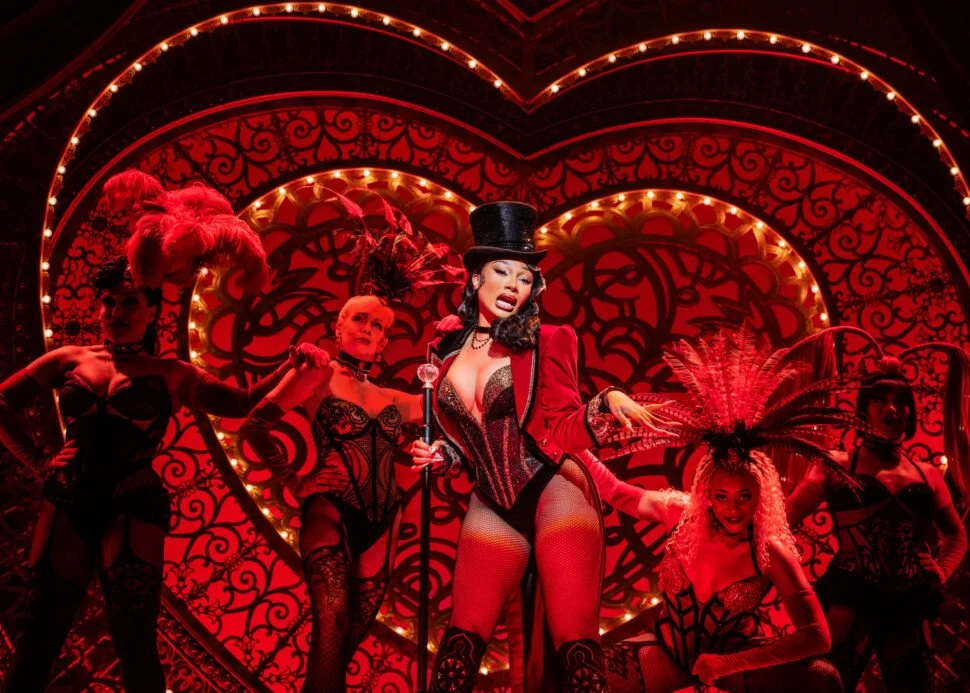
Donnie Hammond, Sarah Bowden, Megan Thee Stallion, Rayven Bailey, and Jeigh Madjus in Moulin Rouge! The Musical (Evan Zimmerman)
by Chris Peterson
I’ll admit, non-appearance insurance is not something I had spent much time thinking about.
That changed after reading a recent piece in The Stage about what happens when “the star of the show can’t go on.” The article explained how non-appearance insurance can protect producers, presenters, or venues when a key person involved in a production is unable to appear.
Honestly, it sounds like one of those deeply unsexy theatre business topics that lives somewhere between contract language, production budgets, and someone in a suit saying, “We need to manage risk.”
But once you understand what it is, it says a lot about where theatre is right now.
Non-appearance insurance is essentially protection for the production when a key person cannot appear. That could mean a star actor, a musician, a director, or someone else whose absence could create major financial damage. It is not really there to protect the ticket buyer. It is there to protect the production.
And that is where this gets interesting.
Because if a show needs to insure itself against one person not showing up, that tells you how much of the show’s financial identity may be wrapped around that one person.
This is the cost of star-driven theatre.
And there are real examples of this kind of coverage mattering in the broader live entertainment world. It was reported that blues musician Joe Bonamassa received $4.4 million in insurance money after his 2020 tour was canceled because of COVID, largely because the policy did not exclude communicable disease. That is not a perfect one-to-one comparison to a Broadway star missing a performance, but it proves the larger point: in live entertainment, insurance is often what keeps a cancellation from becoming a complete financial collapse.
To be clear, celebrity casting is not automatically a bad thing. Stars sell tickets. In an industry where everything seems to cost more by the year, I completely understand why producers would want a recognizable name on the marquee.
Megan Thee Stallion’s recent run in Moulin Rouge! The Musical is a good example of both the excitement and the risk. Her casting was a major Broadway moment. It brought attention and likely people into the theatre who may not have otherwise been rushing to buy a ticket to the show.
Then came the reminder that performers are human beings, not machines. According to People, Megan became very ill during a performance and was hospitalized, then missed the next day’s matinee and evening performances.
That is not a criticism of her. But it also shows what happens when a production’s marketing push becomes heavily tied to one specific name.
If audiences bought tickets because Megan Thee Stallion was in the show, then her absence becomes more than a casting change. It becomes a financial, customer service, and expectation-management issue.
That is the risk in building the sales pitch of a production almost entirely around one person.
If the poster, the press campaign, the ticket pricing, and the urgency are all built around seeing that specific actor in that specific role, then the production cannot be shocked when that actor’s absence becomes a financial problem.
Yes, the understudy may be excellent. But that is the artistic side of the conversation. The business side is different.
If someone paid a premium price because a famous actor was above the title, they may not feel they received what they paid for if that actor is out. That does not mean the understudy is lesser. It means the production’s own marketing taught the audience what to value.
Again, I am not saying producers are wrong to protect themselves. In 2026, producing theatre is brutally expensive. One canceled performance can mean refunds, exchanges, lost revenue, angry patrons, and a whole lot of damage control.
So yes, it makes sense that producers would insure against that kind of loss.
But it also reveals something important. Star casting may help get a show open, but it can also make the whole operation more fragile. The more a production depends on one person, the more exposed it becomes when that person cannot perform.