Geno Segers Apologized to “Affected Communities.” That Is Not Enough
by Chris Peterson
Geno Segers has issued a public apology after we reported on a years-long pattern of videos in which the actor mocked, misgendered, and questioned transgender people.
Transgender people were not the only ones owed an apology. Segers’ commentary also included offensive remarks about other members of the LGBTQ community and women. Yet none of those groups are directly named in the statement he has now released.
Our coverage documented videos dating back to at least 2023. Several remained publicly available until Segers’ casting as Hades in Hadestown brought renewed attention to his social media history. As reporting circulated and criticism intensified, videos began disappearing from his accounts. His Instagram was also made private.
The controversy ultimately led the production to rescind his casting. Segers has now responded with a statement on his Instagram.
Here is Segers’ statement in full:
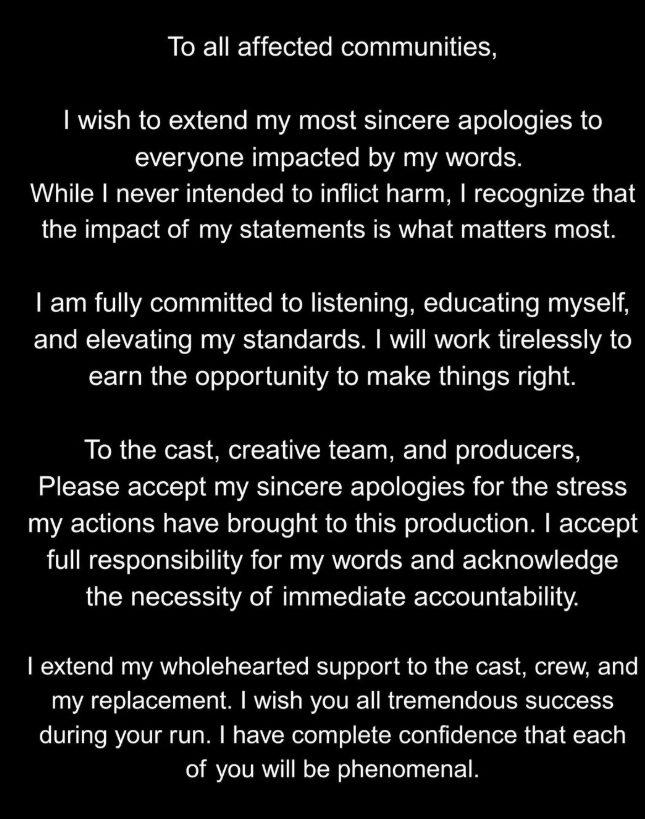
To all affected communities,
I wish to extend my most sincere apologies to everyone impacted by my words. While I never intended to inflict harm, I recognize that the impact of my statements is what matters most.
I am fully committed to listening, educating myself, and elevating my standards. I will work tirelessly to earn the opportunity to make things right.
To the cast, creative team, and producers,
Please accept my sincere apologies for the stress my actions have brought to this production. I accept full responsibility for my words and acknowledge the necessity of immediate accountability.
I extend my wholehearted support to the cast, crew, and my replacement. I wish you all tremendous success during your run. I have complete confidence that each of you will be phenomenal.
The statement begins by addressing “all affected communities.” To me, that is an oddly vague way to describe the people harmed by his words. The controversy involved his repeated commentary about transgender people. Yet the word “transgender” doesn’t appear anywhere in the apology.
Neither do the specific actions that caused the backlash. Segers doesn’t acknowledge that he mocked transgender people. He doesn’t address his repeated misgendering of trans people. He does not say that he mocked transgender people. He does not address his repeated misgendering of them. He does not acknowledge the remarks he made about other LGBTQ people or women. He does not identify which statements he now believes were false, cruel or harmful.
These omissions matter because this wasn’t one careless remark. Before Segers began deleting videos, his public accounts showed a pattern of content mocking and questioning transgender identities. Some of the videos remained online for years. He repeatedly chose to record them, title them, and share them publicly.
Then, once those videos began receiving wider attention after his Hadestown casting, they started disappearing.
Instead of addressing that history, Segers writes that he “never intended to inflict harm.”
That sentence immediately shifts attention toward his intentions. People were responding to content Segers deliberately produced and published over an extended period. Whatever outcome he intended, the statements themselves weren’t accidents.
Segers promises to listen, educate himself, and “elevate” his standards. What does he need to learn? Whom will he listen to? Which of his beliefs does he now recognize as harmful?
He never says.
Segers says he accepts “full responsibility,” but full responsibility requires naming what you did. It means explaining why it was wrong. This statement does none of that.
Instead, it offers broad language about listening, learning, and working tirelessly. Those sentiments may be sincere, but they don’t answer the central question.
Does Geno Segers now understand that his years of commentary about transgender people were harmful, or does he simply regret that we found the videos and that they cost him a major role?
An apology that refuses to name the people harmed or the conduct that caused the harm is not full accountability. Segers deleted the videos. This statement feels like an attempt to delete the context.