The Patriot’s Benjamin Martin Is the American Story — Flaws and All
Greg Ehrhardt, OnScreen Blog Editor
As America prepares to celebrate its 250th birthday, there will be endless rankings of the greatest patriotic movies ever made. 1776 will get mentioned, well, at least if Chris Peterson and I have any say. Saving Private Ryan should be on any list, along with Glory, Miracle, and Patton. Somebody (maybe me) will also try way too hard to convince you that National Treasure is a patriotic masterpiece.
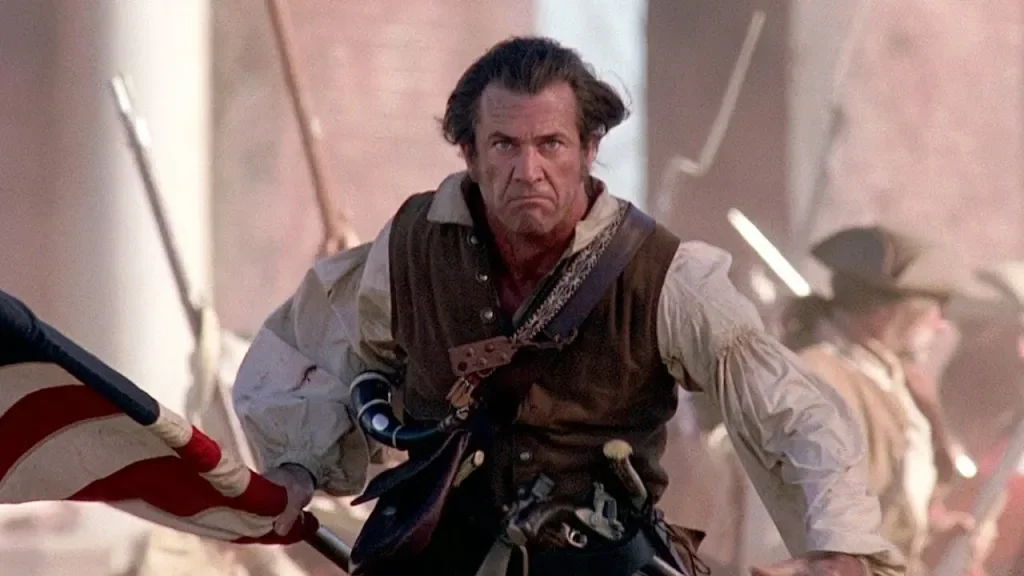
But honestly? The Patriot is one of the best stories ever told on film about what patriotism means and what it should be, because there may be no better statement on what it means to be American than the lead character Benjamin Martin embodies in The Patriot.
And no, it’s not because he waves the flag in slow motion in the final battle while James Horner’s score swells in the background.
It’s because Benjamin Martin represents something deeply embedded in the American identity that most patriotic films don’t deal with: the idea that flawed, broken, violent, immoral people can still choose to build something better for themselves, and for others.
Benjamin Martin represents the idea that Americans, and America itself, can ask for forgiveness and redeem themselves.
That’s what The Patriot is about, and that’s why Mel Gibson’s performance in this movie has aged far better than people want to admit, way better than what many consider to be his masterpiece, Braveheart.
When we first meet Benjamin Martin, he is not a patriot or a revolutionary. He is not even particularly brave emotionally.
He is afraid: terrified, actually.
He actively argues and votes against waging war against England, and for somewhat understandable reasons. It’s partly because he is a single father, even though as his son Gabriel points out, its more of an excuse than an explanation, but more because he knows what war can be, having committed war crimes under the British flag, and he has such regret about it that he cannot possibly go near war even though this time around it is way more justified than the French and Indian War.
We don’t typically get protagonists who are completely afraid of their demons.
Martin once committed atrocities so horrifying during the French and Indian War that hardened soldiers still speak about “Fort Wilderness” like it was something out of a nightmare. Interestingly, none of his colleagues were as spooked about it after the fact as Martin was.
But that’s part of the genius of the character arc; Martin, the one who committed the acts, hates what he did, but he’s alone in that, at least on the colonial side.
"I have long feared that my sins would return to visit me, and the cost is more than I can bear." Martin says during the movie.
That line is the entire character in one sentence (well, at least until the end).
Benjamin Martin is not haunted by war; it hurt him.
He is haunted because he knows what he became during war. And he fears he will never get past it.
Martin believes God is punishing him for what he did. He thinks his wife’s death was payment. Later, after Gabriel dies, he still refuses to learn the correct lesson from his suffering.
Instead, he concludes that life itself is cruel and that trying to fight evil only creates more evil and destroys the people you love.
There’s a devastating line after Gabriel’s death where Martin basically admits defeat emotionally. The movie never turns him into some chest-thumping freedom warrior overnight. He retreats inward again because, as those who have dealt with life-altering mistakes know, retreat is the only survival mechanism.
He almost lets his sins defeat him. He feels there is no redemption for what he has done
And that’s what makes the character feel so American, and human, to me.
Because the real American story is like Martin’s. Martin was a broken, flawed man wrestling with whether the American ideals are even worth believing in. Sound familiar? We hear a lot of this refrain when people argue that America’s original sin of legalizing and practicing slavery stains any notion of being a nation founded in individual liberty.
But what makes Martin such a great character is his arc. His story doesn’t end with Gabriel's death. Like most great character arcs, his journey spans the entire movie to reach the endpoint. (This has been my struggle with Braveheart; whatever character arc there was for William Wallace was reached by the middle of the movie)
When Martin sees Gabriel’s flag, the flag Gabriel risks his life over, the path to redemption crystallizes.
He can choose to fight for a better future, for himself, and the country. If he doesn’t fight, men like Colonel Tavington, who committed his own atrocities with zero regret, win, and the cycle continues.
That’s the climax of the character, and that is the ideal we should believe in for America.
Some people think America’s original sin of institutionalized slavery and racism is irredeemable. If that’s true, then why fight for anything better?
We fight for better because better is always possible. America was not a finished product in 1776, or 1859, or 2025.

America has not always lived up to its ideals. God knows it hasn’t.
But because America at its best is rooted in the belief that human beings are not trapped forever by their failures. That imperfect people can still strive toward better principles. That redemption is possible through action instead of isolation.
America is going through that arc right now, not as quickly as many people want, but it has. Life for everyone has improved dramatically over the past 250 years. And it’s going to get better, but only if we keep fighting for it.
I look at America’s 250th birthday and choose to rejoice at how far we’ve come, not to get depressed over the mistakes and atrocities the country has made getting to this point.
Because here’s the thing: no one is perfect. Everyone chooses wrong at some point. The “bad” people are those who think about those choices and feel no regret or responsibility, for whatever reason, like Colonel Tavington, for example.
The “good” people know what they did was wrong, and instead of sulking about it, they fight to redeem themselves and to build a better world for others.
That is patriotism at its finest.
America wasn’t born great. It’s growing, maturing, always learning, and getting better every day.
Sound familiar? That’s Benjamin Martin’s story, and it should be all our stories as well.