U.K. Theatre Group Cancels Dreamgirls After Rights Pulled Over Predominantly White Cast
by Chris Peterson
A planned U.K. production of Dreamgirls has been canceled after the rights holders withdrew permission for the show to move forward following complaints over the production’s casting.
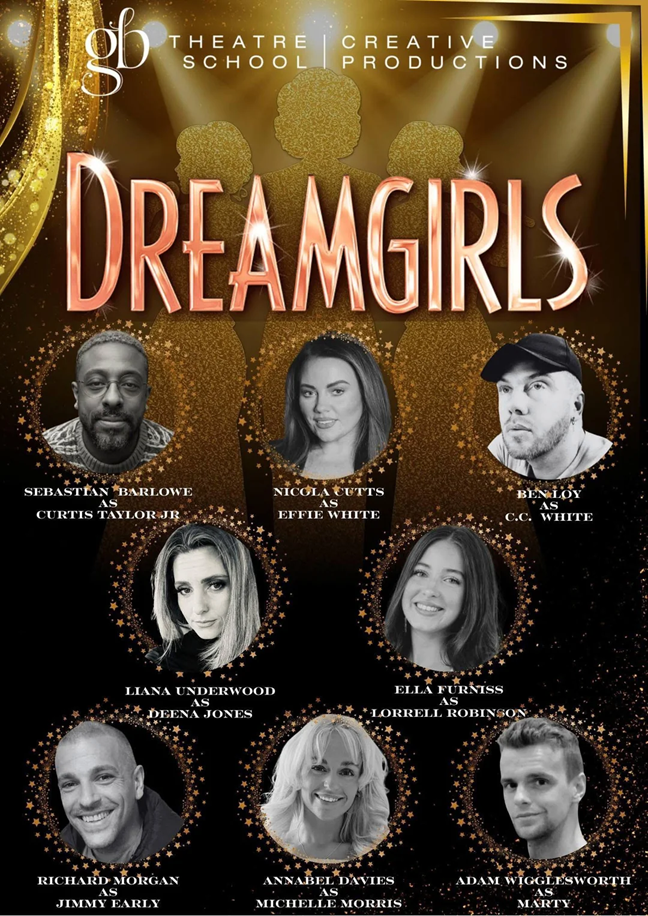
South Yorkshire’s Gillian Banks Creative Productions had previously drawn criticism after announcing a Dreamgirls cast in which nearly all of the principal roles, with the exception of Curtis, were played by white performers. The cast photo from the theatre’s original social media announcement can be seen below.
In a statement posted after the cancellation, the company said it was “incredibly saddened” to announce that the production would no longer go ahead “due to circumstances completely outside of our control.”
According to the statement, complaints had been made directly to the rights holders regarding casting requirements. The company said it was then informed that “the licensing conditions for the show have changed with immediate effect,” and that, as a result, the rights for the production had been withdrawn.
“When we originally secured the performance rights, there were no restrictions or conditions provided regarding the ethnicity of the cast,” the company wrote, adding that all casting decisions were made within the original licensing terms. The company also said the rights holders acknowledged the situation was “through no fault of our own” and that licensing fees would be refunded.
The group said the cancellation had been “absolutely devastating” for the cast and creative team, who had spent months working on rehearsals, vocals, choreography, and preparation. The company also said every member of the cast had its full support.
“They have done nothing wrong, and we could not be prouder of the professionalism, commitment and talent they have shown throughout this process,” the statement read.
Rather than canceling the performance week entirely, Gillian Banks Creative Productions said it is now creating a new variety production in the same slot, featuring “Motown, musical theatre and jukebox classics” and using the same cast.
The licensing page for Dreamgirls has also been updated to make the casting expectations explicit. Concord Theatricals now lists the principal roles of Effie, Deena, Lorrell, Michelle, Jimmy, C.C., Curtis, and Marty as Black, along with several supporting roles. It also includes a casting note stating that Dreamgirls is about “a time in Black American music history” and that productions “must be appropriately cast to represent and reflect these artists and their history.”
“Casting Note: Dreamgirls is a show about a time in Black American music history when rhythm and blues blended with other styles of popular music, creating a new American sound. It tells the story of the Dreamettes and celebrates their rise to fame, echoing similar trajectories of iconic Black girl and boy groups of the time, like The Supremes, The Marvelettes, The Temptations and The Shirelles. Your production must be appropriately cast to represent and reflect these artists and their history.
Company members must match the character definitions as set forth above.”
Good. Honestly, good.
Credit where it is due: the rights holders did the right thing here, just as the creative team at Hairspray also saw the problem, closed the loophole, and made the expectations clear, That is exactly what rights holders should do when a production exposes the gap between what a licensing agreement technically allows and what a show ethically requires.
Because apparently, in 2026, we still need to write down “please do not produce Dreamgirls without Black people” in official licensing language.
Wonderful. Fantastic. Love that journey for us.
But I’m not letting Gillian Banks Creative off the hook just yet.
The company frames this cancellation as “due to circumstances completely outside of our control,” which is a fascinating way to describe the consequences of choices made very much within their control.

Yes, maybe the original licensing agreement did not explicitly say the roles had to be played by Black performers. Fine. Congratulations on finding the loophole.
The issue was never simply whether the company broke the rules. The issue was whether anyone involved stopped to ask the most obvious question in the world: Should we be doing Dreamgirls if we cannot cast Dreamgirls?
That question got lost somewhere between the vocal rehearsals and the Facebook post about authenticity.
And then there is the replacement production. Because, after Dreamgirls was pulled following complaints about a lack of Black representation in a musical rooted in Black music history, the company is now putting together a variety show featuring Motown hits that they’re calling “One Night Only”.
I’m sorry. What?
You were told, in the clearest possible institutional language, that this may not be the lane for you. And the immediate response is, “No worries, we’ll just do Motown instead.”?
My head has bruises from banging it on the wall just now.
In the end, this was a theatre company choosing a culturally specific show without the cultural understanding, casting, or common sense needed to produce it responsibly.
Sometimes the most respectful artistic decision is to pass on the show. And if the rights holders had to step in to make that decision for them, then thank goodness somebody finally did.