The Line Delivery That Made Me Sit Up Straight
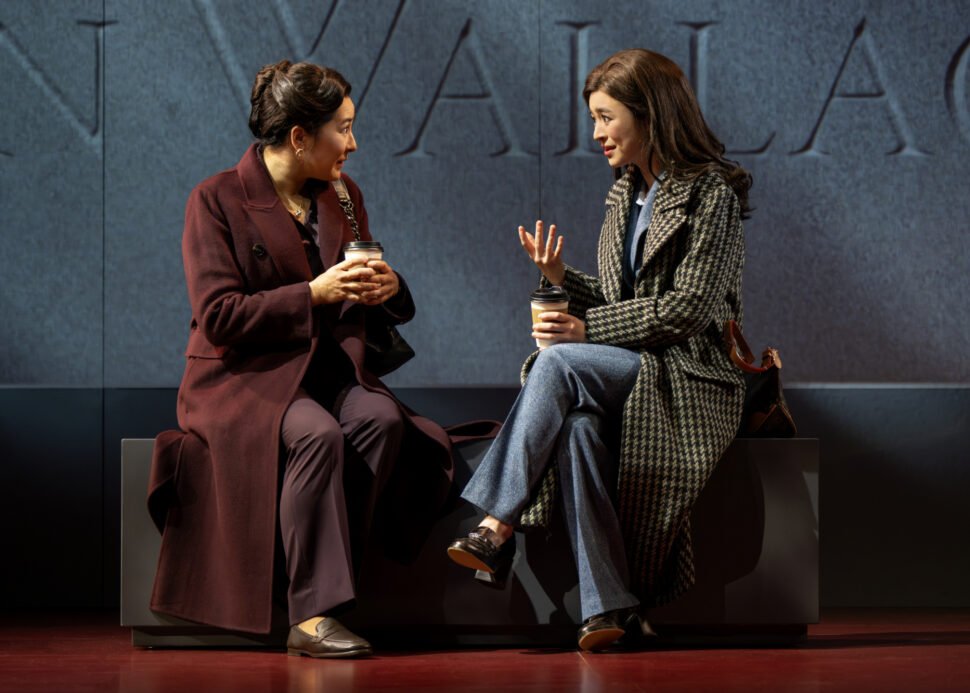
Jennifer Ikeda and Anna Zavelson in Chinese Republicans (Joan Marcus)
by Chris Peterson
There’s a particular kind of actor bravery that never shows up in a Playbill bio.
It’s not the “I can belt to the back wall while doing a backflip” kind of bravery. It’s not even the “I’m going to cry on cue eight times a week” kind. It’s the smaller, scarier one. The one where you’re standing onstage in front of an audience that absolutely has expectations and you decide, in real time, not to give them the line delivery they think they’re about to get.
I’ve been thinking about that a lot since seeing Chinese Republicans Off-Broadway.
On paper, the setup is deceptively familiar: a corporate environment, ambitious professionals, relationships that look polished until you realize how much of that polish is actually pressure. The play lives in that uneasy space where race, power, belonging, and survival are all tangled together. Everyone is “fine,” everyone is “professional,” and meanwhile, you can feel the emotional violence humming underneath the fluorescent lights.
And in the middle of that is this dynamic between Ellen and Katie that’s just… deeply watchable in the way a quiet storm is watchable.
Ellen is the kind of person who knows exactly how to hold a room. She’s sharp, controlled, and carries herself with the energy of someone who has made it this far by learning what not to reveal.
The much younger Katie, on the other hand, feels like she’s constantly negotiating how much of herself she’s allowed to bring into the space without being punished for it.
It’s not a simple hero-villain relationship. It’s more complicated than that. It’s mentorship tangled with rivalry.
Which is why the line deliveries matter so much in this show. They are the show. People talk about “writing” as it lives on the page, but the truth is, the writing becomes real the second an actor decides where to breathe, what to swallow, what to let hang, what to throw like a dart.
And Jennifer Ikeda, who plays Ellen, made a choice that I’m still carrying around in my pocket like a little stolen souvenir.
Without spoilers (because the line is pretty much the climax of the show), it happened in a heated moment with Katie (spiritedly played by Anna Zavelson), one of those exchanges where you can practically feel the audience lean forward because we all know the usual rhythm. The pause is coming. The actor is going to take a beat, let the revelation land, let the wound show. It’s a familiar little piece of stage grammar.
Effective, honestly. It works for a reason.
But Ikeda didn’t do that.
Where most actors would have opened the door to silence, she snapped right back. Not “big,” not showy, not a wink to the balcony. Just immediate. Instinctive. Like her body refused to grant Katie even a fraction of sympathy in that moment. The exchange flashed, and then it was gone, like we saw a glimmer of a different person for half a second, someone rawer and less managed, before she slid right back into Ellen’s armor. Back to control. Back to composed. Back to being the kind of antagonist who doesn’t have to raise her voice to make the room colder.
And I caught it right away. Like, my brain did that thing where it stops listening for plot and starts watching craft. You know what I mean. You stop being an audience member and become a little goblin of admiration.
“Oh. Oh, that’s smart. That’s dangerous. That’s specific.”
Because here’s what that choice did, and why I’m praising it like it paid my rent.
First, it didn’t let the scene become predictable.
Theatre audiences are sweet, but we are also trained. We can smell a “pause for impact” from the lobby. We know when the actor is about to “act” the feeling instead of living it. And sometimes a pause is exactly right, but sometimes a pause is just… the default setting. The safe option. The “this is how this line is usually done” option.
Ikeda’s snap-back yanked the whole exchange onto a different track. It made the tension feel more honest. Like these people are not participating in a tidy little power ballet. They’re reacting. They’re surviving.
Second, it told me something about Ellen that I wouldn’t have gotten from a pause.
A pause can communicate hurt. It can communicate restraint. It can communicate calculations. All great things. But an immediate response can communicate something else entirely: refusal. Control. A kind of self-protection that’s so practiced it doesn’t even feel like a choice anymore.
That’s not just a “line delivery.” That’s backstory.
Third, it made the moment smaller in the best way, which somehow made it bigger.
Because the most impressive acting choices aren’t always the ones that scream: “Look at me!”. Sometimes the most impressive choices are the ones that happen so quickly you almost miss them. Almost. But you don’t, because your gut knows something just shifted: a tiny change in tempo, and suddenly the scene feels like it’s happening for the first time.
That’s the magic of bold, unconventional line deliveries when they’re done well. They don’t feel unconventional. They feel inevitable.
And let’s be honest, actors get subtly punished for making choices like that.
If you take the pause, nobody yells at you. If you play the emotion in the “expected” way, you’re rewarded with nods and notes like “great work” and “nice moment.” But if you take a line and twist it, if you mess with the rhythm, if you choose speed over stillness or stillness over speed, you are risking something. You’re risking that it won’t land. You’re risking that it will land, but it will land differently than the director imagined. You’re risking that your scene partner will have to adjust. You’re risking that the audience won’t “get it.” You’re risking being called inconsistent when what you’re actually doing is being alive.
So when I see an actor do it and do it with that level of precision, it makes me want to stand up and applaud the craft itself.
Because the truth is, most great performances are built out of tiny, specific decisions that never get talked about in reviews. They’re built out of moments where an actor chooses to go against the grain, not to be different for the sake of being different, but because the character’s nervous system demands it.
And that’s what I felt watching Ikeda opposite Zavelson. The choice wasn’t decorative. It wasn’t “a take.” It was character. It was power. It was a flash of something vulnerable and honest, and then the mask snapped back on, which somehow made the mask even scarier.
So yes, I’m praising actors who make bold and unconventional choices for line deliveries. Not because I need every performance to be a surprise party. But because the choices that scare actors a little are often the ones that wake the audience up.
And in a piece like Chinese Republicans, where so much of the tension lives in who gets to hold power and who gets told to swallow their reaction, that kind of bravery is not just impressive. It’s the whole point.